INKLINGS # 8.

IRMA’S BIRTHDAY
Irma Wood – 1908 : 2003*

Here, at another table, by another window,
leaning into the lee-side of my own half-century-plus,
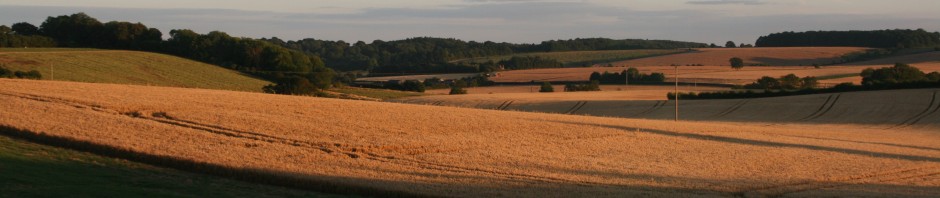
I’m looking out over autumn fields, heavy with the news.
Not so much grief or loss for the motif is gold and red –
riches, even in the curl and fall of lives that burned up to the last.
But some memories are like bindweed
and they grow green around the sinews of time… 

Her birthday supper. Late summer, just like now. Twilight. 
The fragrance, sweet and sad, of burning leaves. The tiny goblin song
from beechwood embers glowing in the black-iron range.
The schoolday’s done. Here, the boarders, round the kitchen table,
knees on chairs, fists bunched under chins,
observing her like naturalists. Candlelight – just the one –
its image doubled in her glasses. Our unthinking love
ticking like a clock that knows nothing of the moments that drive it. 
               
“Irma, how old are you now?” I ask out of nowhere. 
(I have no notion: beyond my sprig of years, from down here
the trees grow high and wide, topless and secret.)
“I’m 50”, she announces. “Half a century today”.
 I am appalled: so close, so very close to death.
With the snuffing of that candle, shadows will gather in this room,
in all the rooms, as they have so often in the dreams I dread. 
We are so fragile. All songs end. Love is paper.
Suddenly but silently I weep
and she leans forward and reads the tears, each one,
and she rises and holds me into her warmth and its good darkness.

*John Wood’s wife Irma – adored materfamilias of the New Sherwood boarders – died in her sleep in 2003 at the age of 95. 

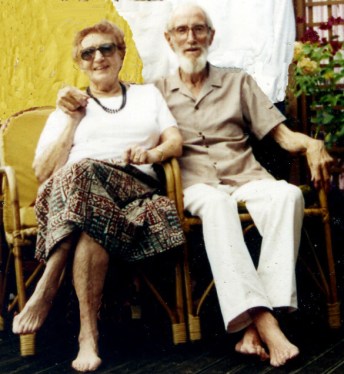
IRMA & JOHN IN AGE.

Irma and John Wood in retirement in New Zealand.

Posted in Uncategorized | Leave a comment

INKLINGS # 7.

New Sherwood School, Worple Road, Epsom, Surrey.
Dad takes the day off work and I climb past the tipping front seat into the back of the red Morris Minor. Mum, in smart Jaeger frock and new perm, sits in the front. At first the landscape is familiar – roads and avenues lined with bulky semi-detached mock Tudor houses, privet hedges, sculpted shrubs and green baize lawns. This is my territory, safe, secure and familiar as a chanted rhyme. Tiny landmarks tick each turning in the old narrative: the street name loosened from its wooden supports; the peeling ad for Sharp’s toffees on a neglected billboard; the pub sign with the wall-eyed red lion forever dancing westwards; the electricity sub-station behind its barred metal fence.

Beyond the Worcester Park roundabout, I’m in an alien land of unfamiliar shop fronts, a car showroom displaying the new Austin Somerset, a railway station hosting a shuffling tank engine behind a line of trucks, a castellated church tower behind a shrill sign – Christ is coming. Are you ready? There’s fear now. Familiar settings but seen through the veil of a dream. Somewhere within this tilted landscape is the school I am to visit. Wrought-iron gates will loom suddenly and behind them red brick walls binding steel framed windows and scuffed swing-doors. And behind them the rush and blunder of uniformed bodies and, moving amongst them, teachers, booming and gesticulating.

A crooked lane off a main road. A ramshackle fence flanking a scruffy two-acre paddock. Then a square wooden board like an estate agent’s sign bearing the words ‘New Sherwood School – 5 to 18’. Immediately beyond it, two high spiked wooden gates, anchored open, letting onto a short unmadeup drive. To the right, a spreading oak tree with a tractor tyre hanging to just above ground level on a long rope. To the left a long, slate-roofed house with a scuffed front door and whitewash flaking from its walls.

Dad parks the car on a patch of cinders and gravel under the oak tree and the three of us clamber out onto the uneven ground. There is the scent of new mown grass and from behind the big house the sound of children’s voices. All is still, suspended in the moment. Then the front door opens and a tall man with thick black hair and a full beard comes striding towards us. He is wearing an open necked shirt, a kilt, knee socks and sandals. He greets me directly in a soft Highland Scots accent, saying his name – John Wood – and asking me for mine. Then he guides us towards an open area beneath a huge beech. There is a small, round swimming pool painted blue, a climbing frame and a pair of ancient steel-tyred cartwheels horizontally attached to posts as primitive roundabouts. John lifts himself up onto the edge of one of them and, with a leg resting on the ground, gently moves himself from side to side as he talks. He ignores Mum and Dad and addresses only me, asking questions in a quiet voice and listening with absolute attention to my stilted answers. He wants to know why I am unhappy at my present school. What is it that scares me? (Long queues; being jabbed in my ribs from behind; the fetid fug of assembly and the grinding hymns that rise out of us like steam; beetroot and parsnips for lunch and Miss Danks keeping me behind until I’ve eaten all mine; sums and the way my hesitation makes Mr. Rossiter shout…) Who are my friends? (Alan Christmas and Clifford Bennett, sword-wielders, train-drivers, word-hoarders, lost souls like me…) Which teachers do you like and why? (Mr. Leary, who laughs a lot but not at you and kneels by your desk…) What would you like school to be like? (Empty. No, closed forever…) What could make school bearable..?

At first my answers are brief and vague, trailing by minutes at a time the voice that speaks so readily inside my head. So I shrug a lot. I look up into the branches of the overhanging beech, squinting against the light between the leaves and let the head-voice dwindle into silence. But it’s too late now and tears fill my eyes. Here are things that I have never allowed to rise to the surface, even when at my most wretched with Mum and Dad either side of me on the sofa, baffled and helpless. What could make school bearable? For there to be no long pipeline corridors full of ragged, jostling queues or tumbling two-way animal traffic; no echoing rooms with blockboard floors and high narrow windows, their quarterlights tipped open to the outside world; no senseless violence in corners of the playground – moments choking against a forearm squeezing my windpipe; no barked commands for hands on heads in the dining room because the babel voices have reached crescendo; no swirling compound signature odour of chalkdust, flower-and-water paste, boiled and steaming food, warm tar, pencil shavings, wet vaporous clothing after rain, baking dust rising from gurgling radiators. No dread before, no fear within. No suffocating sense of sinking deep and drowning, each and every day…

The sun is warm; blackbirds are singing. John Wood watches me gravely. I take a deep shuddering breath. Mum and Dad are watching me too, heads on one side, smiling uncertainly. John asks: “Do you think you might like to come here? Just to try us out for a day?” I look around the untidy campus – an overgrown tennis court, a long rectangular sandpit, two old caravans in the lee of a high brick wall, a ramshackle gabled workshop, trees and bushes. I think that – perhaps, maybe – I might. Just for a day…
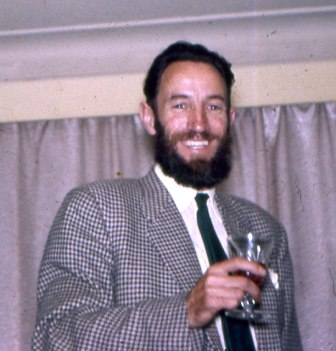
JOHN WOOD

John Wood

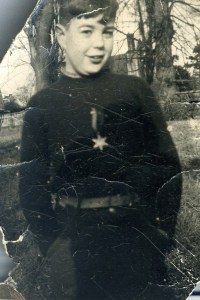
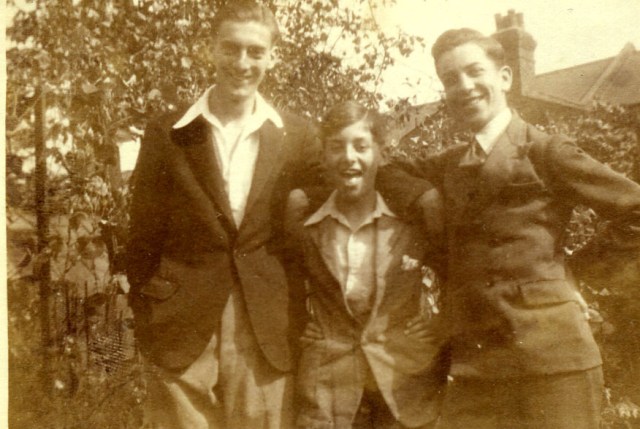
SHERWOOD KIDS

New Sherwood kids.

DJ

Posted in Uncategorized | 5 Comments

NATIONAL POETRY DAY 2017.

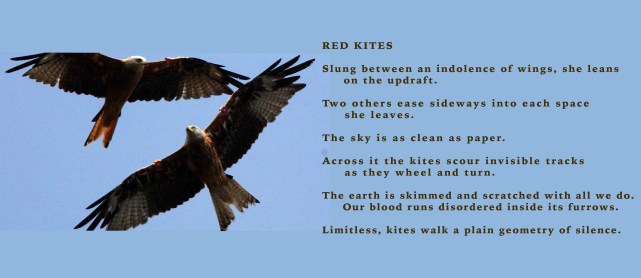
RED KITES

Posted in Uncategorized | Leave a comment

INKLINGS # 6

Latchmere Road Junior and Infants School, Kingston-upon-Thames, Surrey.
The soft crooning of the trolleybus provides a bemused counterpoint to the wracking of my shameless sobs. Mum hugs me tight to her side whilst staring miserably at our dual reflections in the opposite window. An old lady wearing a hat shaped like one of Granny’s dumplings cranes around from a forward-facing seat, her lips alternately pursing and pouting as she tells herself the story.  Across the aisle, a mother with a cavernous shopping bag smiles faintly, head tilted in sympathy.

At the school gates anguish breaks like a cold wave. Either side of the wrought-iron fence, children swarm like flies, wild-eyed and random. The noise is suffocating – the shriek, scrape and clatter of hundreds of urgent lives in collision. Like an invisible gas in a strong wind, the scent of disorder swirls amongst them. I reel with it, fighting for breath. Gently but firmly, Dashing a hand against her own tears, Mum detaches herself from my panicky grip and slips away, amongst the crowding mothers handing over satchels, spit-wiping downturned faces with hankies and struggling with loaded push-chairs. I lean back against the cold bars, my gaze fixed on the turning weathervane on the gable end over the main entrance, one moment pointing the way home, the next towards the terrifying unknown. Numbly, I wait for the first of the whistles and the long, shuffling queues.

John Schofield sits next to me in the double desk. He’s not frightening like Alwyn Dawes, who, wordlessly, chokes the breath out of you in the playground with one arm around your throat and the other behind your neck. But he smells – a pungent mixture of urine, leaf-mould and damp alleys and hallways. He wears boots with laces looped and tied around their tops. There are sores at each corner of his mouth.

As tiny Welsh Mr. Price walks past the desk to take up position at the rear of the room, John places his ruler at the desk’s rim and flicks the end, drawing its length inwards on a jabbering rising note. Immediately he thrusts it into my hands and buries his own under his thighs.  A heartbeat later there is the sound of Mr. Price’s blakeys accelerating across the woodblock floor from the back of the classroom and a stinging slap is delivered to the side of my head. I’m choking with shock, tears springing into my eyes. Then Mr. Price is in front of the desk, his small concave face flushed, inches from mine, his lipless mouth a brief compressed line under his toothbrush moustache. In a swift sequence of movements he seizes the ruler, straightens my fingers and brings the flat of it down across my palm four times in quick succession. Breathing a little harder, he turns away and moves with his springing dancer’s gait towards the blackboard, indifferent now in the wake of justice. My sense of pain, mortification and suffocating unfairness is almost intoxicating. And the hatred that follows – not for John Schofield who merely did what he must do as one who knows no better, but for Mr. Price – is so pure that tears cease and as I begin to breathe again, the world has changed…

SCHOOL GATES

Posted in Uncategorized | Leave a comment

INKLINGS # 5.

Medbourne, nr. Market Harborough, Leicestershire.
Medbourne is, or was back then, a small village a few miles north of Market Harborough in Leicestershire.  My father, a sickly boy of 12, was sent there in 1923 by his parents to stay with friends, George and Nellie Jeffreys. George had been in service with my grandfather, both of them butlers to the diamond millionaire Sir Julius Werner’s household at Luton Hoo in Bedfordshire (only just down the road from where we live now). Subsequently my father, usually accompanied by his younger brother Frank, spent the greater part of every summer at Medbourne until his early 20s. As children, my cousin Linda and I were taken there for a long weekend every summer, the journey made initially in the double sidecar of my uncle’s Ariel VG500, with my father riding pillion and subsequently in Uncle Frank’s Jowett Javelin.

The farmhouse is built of raw red bricks. It is square and functional, with four metal-framed windows and a blue slate roof.  It sits, isolated amongst its fields, on the broad, flat top of Nutbush Hill above Melbourne. The front yard is hard mud studded with flint. Chickens flutter and peck, watched by a gaggle of geese in the lee of the gooseberry bushes. A tortoiseshell cat with matted fur is curled up asleep on the lid of a rain-butt. George’s border collie Jess tugs against the limit of her frayed rope. House martins swoop and skid around the shallow eaves and far above and almost always out of vision skylarks circle, their distant call like squeaky wheels…

The night is clear. I can see a shaft of stars in the gap where the curtains are not quite closed.  After a long, hot day, there is no wind, nothing to shift the crowding leaves of the beeches that line the lane up to Nevill Holt.  A screech owl lifting off the chimney stack splits the brief silence; I hear its wings beat as it curls away to the east.  I breathe deep, listening through the half-open window to the shuffling and cropping of the black-faced sheep slowly orbitting the house in the darkness like dim clouds…

Then suddenly all sound comes from within. Downstairs, in the tiny parlour, they are gathered late around the piano. Auntie Nellie plays – big-fisted chords, plangent & unornamented – and they’re alls singing, Auntie Nellie, Uncle George, his son Malcolm, Uncle Frank and Dad. There’s a long, long trail a-winding, into the land of my dreams. As I enter the margins of sleep, a dream gathers for me too. There’s the complex signature fragrance of the animal shed, the harvested barley, tarry wood blocks burning in the range, the damp undersides of the rhubarb leaves with their cargo of slugs, the frying of bacon early in the morning, sense memories that linger still…

6a00d83451947569e200e553af4a348833-pi

Dad, Uncle Frank and their friend Jack Almond

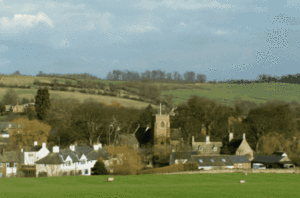
medbourne_2

Medbourne.

Posted in Uncategorized | Leave a comment

INKLINGS # 4.

47 Ritherdon Road, Wandsworth, South-West London.
Nanny & Grandpa Jones live in a flat on the middle floor of a three-storey Victorian semi-detached house at 47 Ritherdon Road in Balham. Mum & Alan drop me off for my weekend visit and I cross a checkerboard of tiles and pass from daylight into a dark hall. Stairs rise to the left; shiny dark brown doors face me; I’m conscious of the stairs that descend into the basement, but I’m afraid to look down into the shadows as I move across the hallway to climb towards the flat. There is an ambient smell – cooking, dust, polish, damp.  It lingers faintly, like distant music; it speaks to me of the past, of the ghosts who are sealed beneath wallpaper and paint.

The kitchen is warm.  Nanny cooks. She slices slivers of butter into a frying pan. The creamy yellow brick that she holds down with her left hand she bought that afternoon at Sainsbury’s in Balham High Street. A bald man in a white coat cut it from a huge block and he beat it into shape with two paddles like cricket bats and then he wrapped it in greaseproof paper. I play at the kitchen table with wooden building blocks, utterly absorbed. They are different shapes, colours and sizes. Some are cylindrical, some rectangular, some square; some are formed into half circles and they accommodate the cylindrical blocks perfectly. These I make into tunnels and bridges as I run my rainbow railway across the table’s rough surface.

At 6.00 PM Grandpa listens to the News from the wireless in the Living Room. He demands total silence. I sit behind his chair with Nanny’s sewing basket, passing a ball of amber beeswax from hand to hand. Its surface is laced with the tracks of the lengths of cotton she pulls across it to stiffen them when she sews by the evening fire. The chair creaks as he leans forward towards the mantelpiece for his pipe and tobacco.  I see his arm reach for a paper spill from the copper container shaped like an ice cream cone. He grunts as he leans across and takes a flame from the fire and I listen to him draw it into the pipe bowl with a reedy crackle. Seconds later the aroma reaches me as he leans back into his cushions. I breathe in its richness.

I sleep in a creaky folding bed placed across the unused fireplace in Nanny’s and Grandpa’s bedroom. The cavity is concealed behind a wooden screen on two ornamental feet. Every inch of it is covered with pictures – items from ancient magazines, newspaper and catalogues, book illustrations, old photographs, box tops, Christmas and birthday cards. Nanny made it, she tells me each time I come to stay, when she was a ‘young married’. As the light fades after bedtime, I study each picture that is visible above the tideline of the counterpane. I lay my head opposite Little Miss Muffet in a hooped skirt and a cartwheel hat and I drift off to sleep…

ritherdon_road_2_2

Alan, Mum (with cat Tarkie), Grandpa & Nanny Jones
outside 47 Ritherdon Road.


Posted in Uncategorized | Leave a comment

INKLINGS # 3.

1, Hockenden Cottages, Swanley, Kent.
My bed at Granny & Grandad Roberts’ house, 1 Hockenden Cottages, is as high as a haystack. I can lean my forehead against the edge of the faded counterpane. The room smells faintly of lavender. The sheets are cool and heavy. The pillows are stacked three deep and I must beat a channel into the centre of the top one with my head. On the mantelpiece is a huge green marble clock, the face set into the portico of a Greek temple. It’s stopped at twenty past twelve.  Above it is a picture of Ruth & Naomi from The Bible. They are leaning against each other, smiling faintly.  I sleep on my back and the picture is the first thing I see as I am awakened by the Essex’s cockerel each morning at 5.30…

Wooden crates with slatted sides are piled high in each of the clearings in the apple orchards that stretch away behind Granny and Granddad Roberts’ cottage. Faded writing is stenciled onto the end panels – McNair Vinson Farms. Gypsy Georgie Essex and I climb high on the rickety stacks. Throwing crates down and shifting others into position, we create a fortress. I curl up tight inside a crate and breathe in the intoxicating fumes of generations of Cox’s pippins…

6a00d83451947569e201538f202b08970b-pi

1 Hockenden Cottages

6a00d83451947569e2014e89137113970d-pi

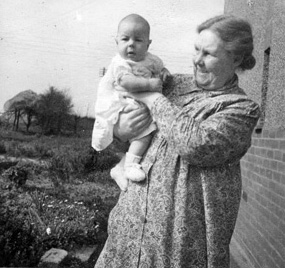
Richard Alan Jones & Granny Roberts

Posted in Uncategorized | 4 Comments

Leigh-on-Sea, Essex.
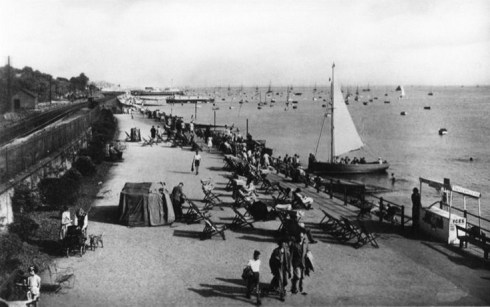
I am being carried down the beach at Leigh-on-Sea. The tide is coming in. The sharp primeval tang of salt makes my eyes smart. I struggle & half fall, half slither onto the sand. My father quickly stoops to gather me up. He is wearing tiny white-framed sunglasses. I can’t see his eyes through the twin round lenses.

38331331a32ade247794d24a2af56d00--leigh-on-sea-river-thames

Posted in Uncategorized | Leave a comment

INKLINGS # 1

I’m posting in slightly revised form a series of autobiographical sketches that I ran originally on my previous blog, Dick Jones’ Patteran Pages.

28a Emmanuel Road, Balham, South-West London.
There is a railway embankment on the far side of a strip of common land opposite the flat in Balham, South-West London.  Clearly visible from the living room window is a siding onto which freight trucks are shunted by a tank engine. The locomotive seems angry: its wheels spin in exasperation and great gouts of steam and sparks are squirted from its chimney. I kneel on a low chest covered with cushions watching, rapt.

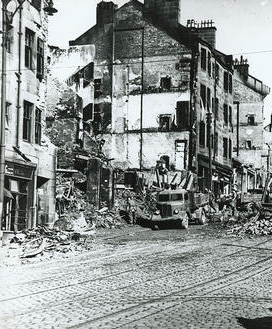
I’m pushed in my pram from Emmanuel Road to Ritherdon Road, where Nanny and Grandpa Jones live.  We pass first through the recreation ground on Balham Common and then through a series of connecting streets, all lined with Victorian terraced houses and short parades of shops.  Even this time after the War, the terraces are punctuated irregularly by partially cleared bombsites. Great A-frame timbers shore up the surviving sections of the terraces. The end walls are naked, two-dimensional cartoons of domesticity: fireplaces, doorways, walls variously painted or papered (kitchens, bedrooms, dining rooms, lavatories), snapped-off joists, some still bearing sections of floorboarding. We pass the boarded-up fascia of the Palladium Cinema, closed since the bombing. Chains and a padlock secure its double doors. A broken shoe lies on its side on the top step. Is the owner still inside..?

tcsa00024_m

Posted in Uncategorized | Leave a comment

TWO FRENCH-CANADIAN POEMS IN TRANSLATION.

oh
by Raoul Duguay

ALL LOVE TAKES ROOT
by Noel Colombier

Because all love takes root
I shall plant it in my garden
I shall plant it with patience
Every day of every season
So that I can offer it in abundance
To all who come to my house
And I shall place it in my windows
To give pleasure to my neighbours
In the village square
At each and every crossroad
I shall offer my flowers equally
To my friends and to my enemies.
Because all love takes root
I shall plant it in my garden
I shall plant it at all frontiers
And on top of all walls that separate.
You who hear my refrain
Carry the phantom fruits and seeds
Into your house.

Posted in Uncategorized | 2 Comments