TWO POEMS BY BLAISE CENDRARS


TS GRAPHIC 1.jpg

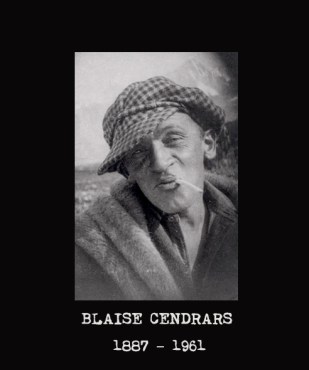
THE HAZY WORLD OF BLAISE CENDRARS by LEE ROURKE
from The Guardian, July 27th 2007

Reading Blaise Cendrars is like stepping into another universe. His fiction is unlike anything else I’ve ever read. His poetry influenced the mighty Guillaume Apollinaire and helped shape the face of modernism. But it is his mockery of biographical detail and the very notion of literature that fascinates me the most. If, like me, you’re not a fan of autobiography, then Blaise Cendrars is the memoirist for you.

Blaise Cendrars – or the “son of Homer” as John Dos Passos called him – is himself a strange kind of fiction: born in La Chaux-de-Fonds of a Scottish mother and Swiss father, he claimed that he left home aged 15 to work in Russia during the revolution of 1905. He was a bee-keeper, a film maker, a chef, a picture-house pianist, a watchmaker, and a traveller with drunken gypsies. He spent the first world war fighting with the French foreign legion, where he lost his arm in combat, became an art critic, befriended Picasso, sailed the seven seas, shovelled coal in China, amassed and lost huge fortunes and had his own gossip column in a Hollywood newspaper. Nobody knows how much of this is actually true. Though he certainly lost an arm in the first world war, it is possible Blaise Cendrars was pulling more than one or two legs.

In fact, Blaise Cendrars isn’t even his real name. His real name is Frédéric Louis Sauser. Blaise Cendrars is a bastardisation of ‘braise’ (embers) and ‘cendres’ (ashes) with ‘ars’ (art) thrown in for good measure. Blaise Cendrars dances on the ashes of outmoded literary styles to create his own pioneering art. Fire is a repeated image throughout his work and it is this insouciance and dismissal of all that came before him that is elementary to his own philosophy: be different and forge the new.

His most famous ‘biographical’ work is the war memoirs tetralogy, consisting of The Astonished Man (L’Homme Foudroyé, 1945), Lice (La Main Coupée, 1946), Planus (Bourlinguer, 1948), and Sky (Le Lotissement du Ciel, 1949). These aren’t your average war memoirs, they are the strangest and most surreal I have ever encountered. Encompassing almost 1000 pages they cover subjects from the bizarre and the surreal: pimps, wastrels, vagabonds, Gypsies, actors, prostitutes, and thieves figure in abundance. It doesn’t matter to me if some of it isn’t true.

The Astonished Man blew me away when I first read it. It is Blaise Cendrars at his very best, a smorgasbord of artists, thieves, and brain-dead sergeants which hoodwinks the reader into believing this magical and horrifying world. It is gonzo journalism 30 years before Thompson and Wolfe, but, unlike most gonzo journalists, Cendrars could write a mouth-wateringly beautiful sentence to boot. We don’t care for fact when we read him. All that nonsense is dismissed. We are hypnotised.

For me, the best memoirists are those who know that all biography is fiction. Cendrars eschews biographical detail and morphs fact and fiction into an elaborate hoax that is both authentic and illusory – the reader is press-ganged and taken along for the ride. Literature should never be anchored or locked. Who needs to be bogged down with biographical fact when such writers hold the keys to our imagination?

o0o

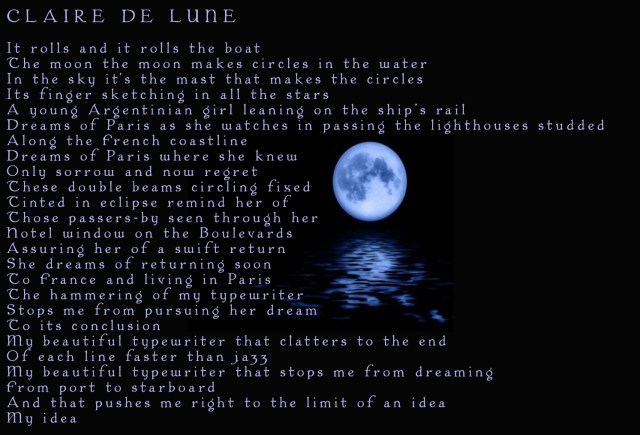
TWO POEMS BY BLAISE CENDRARS
translated by Dick Jones

STARRY NIGHT

CLAIR DE LUNE

Posted in font | 1 Comment

WE ARE.

397458_10152471660375538_279442284_n

WE ARE – audiofile

Posted in font | Leave a comment

INSOMNIA 2.

I’ve suffered from chronic insomnia since childhood. That subtle, momentary wrinkle in the air as you settle into bed that tells you that beyond this point sleep is not an option. And then, recumbent, the staring across the room towards whatever minute source of light might glimmer in a corner as your partner breathes deep beside you and the house ticks into the night…

insomnia


INSOMNIA 2.

Night. From the carbon window
I stare back, a deconstructed mask
amongst trace elements of moonlight,

rain, black leaves. I am part shapes
remembered and part shapes
from out of the sleep of reason.

In this cone of silence just
before the dawn, the shadow
world is palpable: gods

and monsters glide and crawl
by my garden gate. Half-dreams,
uncertain memories, dust devils rolling.

Here and now, I sense, is the pagan
junction where all things meet:
skeletons into flesh, ghosts

into plasma, rumours, fears, the whole
arcana hard wired into the dark.
The night and I, strange company

in a world without hours, no sound
closer than the distant rhyme
of a long train running.

And then, when I turn away
towards my own dark, there’s just
my breath and the falling rain.

From: ANCIENT LIGHTS by Dick Jones

Pic from: http://moca.virtual.museum/donnie2004/images/insom

INSOMNIA 2. – sound file.

Posted in font | Leave a comment

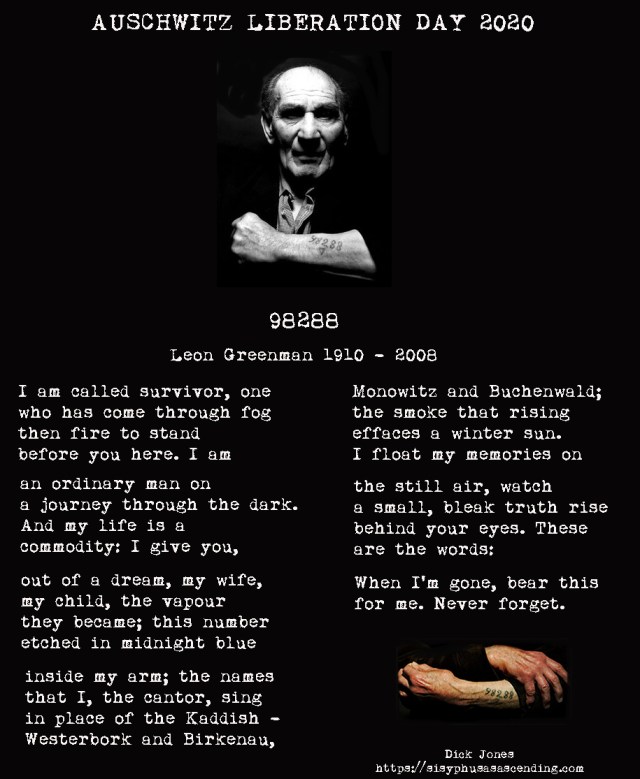
AUSCHWITZ LIBERATION DAY 2020

AUSCHWITZ LIBERATION 2020

Posted in font | Leave a comment

THE LYREBIRD

Lyrebird_by_convict_artist_Richard_Browne

THE LYREBIRD

I am the lyrebird, known as such
              for the shape my tail feathers make in courtship.
Yet I know nothing of the lyre.

I am the mimic, the impersonator.
              In my throat lives the call of the kookaburra.
Yet I know nothing of the kookaburra.

I am the joker, the imitator.
              I can echo perfectly the sound of the chainsaw.
Yet I know nothing of the chainsaw.


Posted in font | 2 Comments

THE SONG’S THE THING!

MOORBY JONES
Steve Moorby : guitar/keyboards/mandolin/pedal steel/vocals
Gemma Moorby : guitar/keyboards/drums & percussion/vocals
Dick Jones : bass guitar/bouzouki

One of the very greatest English singer/songwriters Richard Thompson was asked whether he thought of his lyrics as poetry. He answered: I think they would incorporate a few of the virtues of poetry at one time or another, though in a more dilute form. In a sense, they are aground, lacking the depth to make them float on the cold page, needing the tune to lift them up off the sandbank. There are many poets who have written good, sing-able lyrics, like Walter Scott, Burns Yeats, etc. I think of Leonard Cohen as someone who does both poetry and song well, and it’s interesting, I think, to see how simple his tunes can be to carry various levels of complexity in the lyric.

In respect of my own song lyrics – written these days for songwriting trio Moorby Jones – I’ve always tended to discount them against my poetry, seeing them somewhat as second-class citizens, drones with a narrowly specific role in the scheme of things. Whilst making no great claims for the poems as being driven by the fiery heart and soul, I incline to the subjective view that the creation of a song is more a function of craft processes, like the building of a well-constructed wall. Its principal purpose is to accommodate – to contain narrative and to direct sentiment and to be served in this by an equally skillfully crafted melody. The success of the enterprise is in the synthesis of the two.

Richard Thompson refers to the simplicity of Leonard Cohen’s tunes as the appropriate counterbalance to the complexity of the lyrics and I think that there’s a fundamental equation at work there. Now that Steve Moorby and I have been back in close partnership again for some four years, any new lyric that I write tends to anticipate from the start the kind of setting that Steve will provide. Not that I make any attempt to assemble words towards a particular kind of treatment: it’s entirely a function of the symbiosis that develops between lyricist and melodist. And not infrequently Steve will surprise me with the direction he’s taken so that the contemplative ballad will rock out and the robust narrative will come back reflective and low key.

A case in point is Becoming Ghosts from the album The Open Road. The song was based on a poem written a number of years earlier. The poem records somewhat archly a secret liaison that takes place during a weekend amongst friends and its tone embodies a fleeting encounter that must never be repeated. However, Steve’s treatment drives the transmuted song along with a vengeance, replacing wistfulness with defiance so the original intentionality has no place in the new version.

Here’s the poem…

BECOMING GHOSTS

There’s a bucket of lights on the cliff top
squatting at the track’s end and there is
the great swarm of the summer dark.

Its night-roots are tugged by the sea;
its black branches clog the pathway.
We two climb blind, both naked still

under towelling robes, rime in hair and
on lashes, late love tattooed in wheals
of sand, communion salt on our tongues.

I smile into the darkness. Ahead of me,
a thick shadow, I sense you smiling too.
We’re drawn by obligation and now,

by shame a little: company is waiting on us –
over the breathing of the waves, voices rise
and scatter like sparks, music pumps. Soon

(another stumble upwards, one more turn
through gorse, its candles dimmed) we’ll be of
the world again, restored, reconstituted. And

from thereon, bleached by light, we’ll turn into
a pair of ghosts, doomed, blessed to haunt
each other through the falling of the years.

And here’s the song lyric and the song:

BECOMING GHOSTS

There’s a houseful of lights on the cliff top up high.
At the end of the track there it’s shining.
And the summer dark swarms like invisible wind
all around us where we two are climbing.

There’s sand on our skin and rime in our hair
and salt on our tongues as communion.
I smile in the dark; I know you’re smiling too
as we clamber towards the reunion.

It’s deep into night and we’re stumbling blind
with just candles of gorse here to guide us.
Voices rising like sparks: friends and lovers above
and a world that must shortly divide us.

CHORUS

As we rise into light and our story is told,
we take up our place in the chorus,
ghosts in the present, ghosts in the past,
ghosts through the long years before us.

Posted in font | 3 Comments

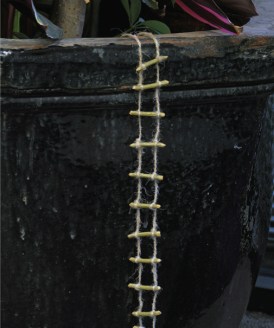
17276-Rope-Ladder

THE TRICK

The trick is
to let slip
the ladder

that brought you
climbing to this
point. Unknot it,

let it fall away.
Then reach up
through the half-

dark and flick
the latch and let
the shutter fall.

No route back
down to how
it never was;

no liar’s light
above on how
it’s never going

to be. Just
this moment,
then the next

and darkness
either side.
Like any trick

worth knowing,
it’s a lifetime
in the learning.

Posted in font | 3 Comments

parting_how_to_1

PARTING, HOW TO.

Conventionally, lovers should part
in a soft storm
of blown hopes
and unconsumed potential.
Tears blur
the old horizons
and refract a new world
where one is the number.

Some might perceive a beauty
in this crafted heartbreak, others
simply paradox:
from the grit of parting
the tears that form
are like pearls.

Or blood may be shed:
spitting slanders
the lovers may wheel and dive
like wolves in a corner,
the one heartsick
on the arsenic of betrayal,
the other punch-drunk
on guilt.

Little to choose, maybe,
between the vale of tears
and the killing floor,
but passion spent
and smoke where once there was fire
are markers for despair.

The truth is more prosaic.
Just after dawn
they’re sitting in a car.
The street is narrow
and the houses small and terraced.
The engine mutters
and he leaves it running,
a monologue all about departure.

A man clips a breakfast rose
and goes indoors.
“Gather ye rosebuds while ye may”,
she murmurs
and the silence shivers
but it doesn’t break.

He lifts her tear
onto his knuckle,
tastes its salt as last communion.
He floats the final words
and they remain face up,
their shadows hanging.
She steps out
and he drives away.

:::

Posted in font | Leave a comment

UP

pigeon_dawn_800

UP

The ice is melting.
It pinks and shivers
like thin music. Black

windows in the ground
go soft and vanish.
Cobweb dewdrops glow

like moonstones in the
dark blue before dawn.
You wake. You breathe

deep. First light, bright
like spray across the ceiling.
You’ve slept and dreamed

beneath this cracked map
of an inverted world
too long. You’ve read

your fortune in its
one-lane highways,
nowhere roads too long,

looking for compass north.
Now the ice is melting. Breathe
deep. Rise into light.

UP read by Dick Jones

FIRST LIGHT – Brian Eno and Harold Budd

Posted in font | 2 Comments

death1


EVENT HORIZON

I saw Eternity the other night
Like a great ring of pure and endless light…
HENRY VAUGHAN

A dark treat, this sudden encounter with death.
Entering the unlit room and expecting
the shadow-flicker in his neck,
the guttering fuse, she saw instead
that he lay quite still and that
a fine silver dust hung in the air.
Silence boomed in her blood.  She forgot
to breathe.  She stared into the hole in time
through which he’d slipped .  She saw dark wings
that beat too fast for angels’, saw
the place where bones come from
and where bones go.  All this in a heartbeat –
wiser than scripture, swifter than light:
a destination on the other side of grief.

Posted in font | 6 Comments