ABU WARD…

‘Abu Ward − whose name means “father of the flowers” − nurtured and tended to the plants that flourished under his care even as Aleppo and its inhabitants continued to die around them. “My place is worth billions of dollars” he told a video journalist for NBC News.  “I own the world! We ordinary people own the whole world!” he said with a smile.

Six weeks after the filming of the NBC News video, Abu Ward was killed instantly by a bomb dropped near the living oasis he had refused to abandon.

The garden center is now closed and the beacon of light and hope that used to emanate from it has now been covered by the same shroud of death that has covered so many in this dying city.

Young Ibrahim has been devastated by the loss of his father and has no idea what he will do now…’

R. Sikora, Orient Net, 29.08.2016

ABU WARD

Posted in Uncategorized | Leave a comment

THERE IS A COURTYARD…

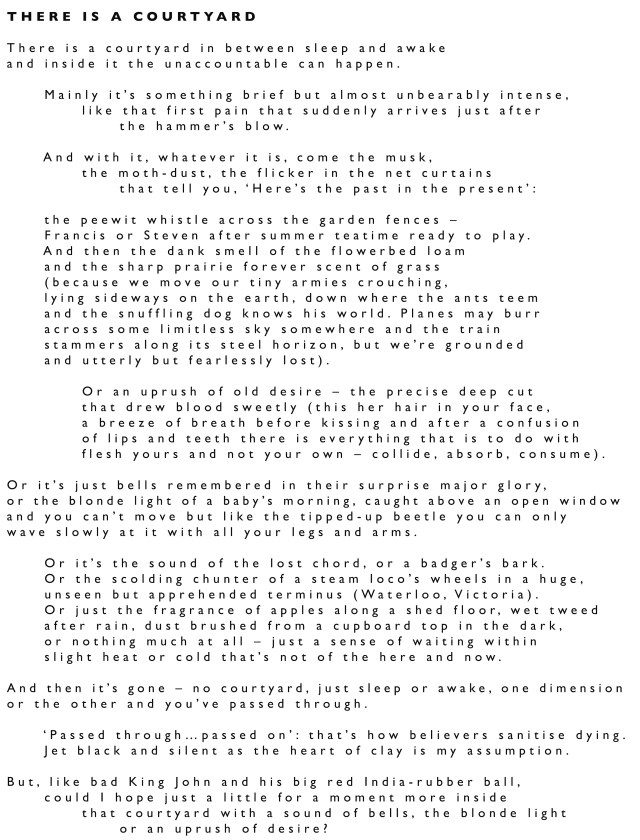
THERE IS A COURTYARD

For better or worse, this emerged more or less intact the other morning. I hope that it indicates that a door closed for a very long time has creaked open a little.

Posted in Uncategorized | Leave a comment

AFTER THE EVENTS…

All tests, checks and balances have been conducted; all results are in. The bladder biopsy showed negative; the bone scan showed clear; the CT scan indicated no lymph node activity. My overall condition remains as it was, of course, and the treatment process will begin shortly. But that all-important (indeed, crucial) pair of states, knowledge and understanding are in place and with them a sense of clarity replaces the clouds of unknowing that so effectively obscured confidence and functional capacity. So the business of ‘staying alive’ becomes a plausible process once again and purpose and enterprise are restored. Anxiety will dominate my days and nights for as long as that cycle of light and dark continues for me. But when made subject to knowledge and understanding, it’s manageable.

Posted in Uncategorized | 3 Comments

CALLING TIME.

CALLING TIME

First, try the wry smile over the rictus of despair.
And then hope for a heartbeat steady as a pocket-watch
against the busted ratchet spinning free.

Then run your eye along the familiar horizon: so many trees
in full leaf, binding the hills, holding up the sky. And reflect:
Here’s where I’m at again inside another cockeyed morning,

under another sun, the same as its siblings, before and to come,
watching those clouds, each one so true to itself until it isn’t.
Step back, step forward, step away. Everything’s a beginning.

Posted in Uncategorized | 4 Comments

SCANS…

This morning a bone scan at Addenbrooke’s. Tonight the results of my biopsy. Tomorrow a repeated CT scan to check whether lymph activity is still in place. For me, the perfect storm. My vivid narrative ‘what-ifs’ – played back again and again during the times of the most intense health anxiety – always featured multiple investigations with lengthy periods of waiting before the omniscient (and thus omnipotent) doctors revealed their verdicts.

And here I am now, within that perfectly imagined narrative. And has it achieved its putative objective of acquainting me with every possible outcome, including the worst? No. In spite of the histology-based scenarios outlined by an oncologist I have no reason to  mistrust, the fear remains in place, undiluted, pure and potent. Why? For all my three years of counselling and constant self-interrogation, in terms of a delineated outline of what forces have shaped me and brought me to this point, I’m none the clearer.

Posted in Uncategorized | Leave a comment

STAYING ALIVE…

When we’re born we come into the world in anger and confusion: all this cruel light, this abrasive air, the tyranny of gravity, these harsh voices… And then, as we breathe deep and the world embraces us, we embrace the world.

From which point the heart becomes that eternal clock, the one whose muffled, unregarded tick never falters. And life lives us, drawing us on through pleasure and pain, rewarding the activated senses and healing the spirit and the flesh. We need do no more than eat, drink, sleep, love and be loved and, however disorientating the nighttime dreams, we wake into certainty and rise into light.

All of which  – within the constraints of occasional pauses for existential reflection – was my experience until 7 years ago when I got cancer. From the point of diagnosis I had to begin the entirely counter-intuitive process of recognising that within me now was the agency of my death. If simply ignored, at some point the cancer would grow to untenable size and it would metastasise, moving onto soft tissue and bones so as eventuality to stifle life functions, at which point I would die.

Fortunately progress towards its blind self-extinction inside the host that, if ignored, it would certainly kill has been slow. With the help of my oncologist, I have been able to monitor its movement and he has assured me that, with necessary management by him, I should be able to head towards my 80s in whatever strength and vigour I can maintain through self-care. By which time, he asserts with all the informed optimism of a medical man whose own health will be subject at that point to the depredations of ageing, dynamic strategies currently in preparation will then be readily available.

I’m close now to the beginning of the treatment processes necessary to keep the cancer under control. Nothing as invasive and peripherally destructive as chemotherapy, but still involving the introduction into my system of materials not natural to my metabolism. I shall have to exercise and I shall have to regulate further a diet that acknowledges cancer already so that my general health – whose overall robustness reflects both my parents’ genes – will be sustained.

None of which practical activity alarms me greatly. Bridges will be crossed on arrival and provided that I know they’re a firm and stable part of the route, I’ll negotiate them readily. What will take a great deal more courage, resolve and positivity is anxiety management.  Since 2008 I have been prone to chronic attacks of dread and the despair that results when all reason fails to dispel it. Both counselling (most of it useless, some of it invaluable) and self-analysis have begun to account historically for these terrifying and disabling torrents of emotional activity and the anxiety is now in the main spasmodic and transient. But there remains at its root a simple, undiluted fear of dying. Not of death as such, but of my atrophying, dwindling, withering towards extinction with those I love and who love me fading away around me. A common enough horror, of course, but  one whose detailed, narrative malignancy is unique to each individual.

So I’m about to move from that state of personal immortality – the quiet, unarticulated certainty that, for all the sometime terrors, life is living me and I need do no more than float within its current – to a state of staying alive as result of direct intervention. I must  indeed now ‘strive officiously to stay alive’. What I can’t know at this point is how that’s going to affect my existential consciousness – whether it will provoke in me a sense of massively increased fragility and vulnerability or whether it will promote instead an enhanced sense of the value-beyond-reckoning of the moment. I have a notion that although the assaults upon its integrity will many and constant, the latter sense is more likely to prevail.

Finally, I have to make it clear to the demons and saboteurs whose work confounds our best hopes and intentions (and a tenacious, bone-deep apparent belief in whose existence confounds my atheism!) that I am aware of the certainty of raid and ambush. That the interposition of nothing malign and morbid – heart attack, neurological decay, dementia – would surprise me on my way towards, into and (who knows?) through my 70s and 80s. Staying alive is an aspiration backed up by my oncologist’s knowledge of my now long histology; the precise vicissitudes of everything else are as unpredictable as the next moment. Or the next, or the next…

Posted in Uncategorized | 6 Comments

TO HAVE AND HAVE NOT… When the muse goes west.

I wrote my first poem at the age of 15. It was a war poem depicting my experiences in the trenches during the first Battle of the Somme. Or, to be more accurate, distilling the experiences of a range of the First World War poets we were studying at the time and then filtering them onto the page via my attempts at jaded profundity within an ABAB rhyme scheme. Shortly after that I performed a similar service for the then very current Beat poets, distilling and then filtering onto the page their accounts of narcotics-fuelled road trips between New York City and San Francisco and the sexual marathons that took place both at either end and in transit. In these early poetic endeavours I was very fortunate to have the patient and forbearing support of my English teacher, the poet Brian Merrikin Hill. He would read these feverish creations carefully and manage through the elegantly tactful manipulation of his critiques to encourage me further whilst suggesting gently that I try to tackle themes a little closer to home.

There’s no doubt in my mind all these years on that without Brian’s gentle, tactful support at that time, my verse-making would have been limited to the hormone-driven years of adolescence. But beyond my own callow attempts at emulating the war poets and the Beats, Brian instilled in me and many of my contemporaries an enduring love of poetry and a recognition of its unique role in the deployment of language beyond all of its semantic and expressive limitations. Everything that I have written in the decades since my five years at Wennington School has sprung from an active taproot running back to that time.

Deriving from that period too is a sense of identity. In an unfussy, unpretentious way, Brian established the status of ‘poet’ as being as legitimate and substantive a self-ascribed status within the arts as ‘painter’ or ‘musician’ or ‘dancer’. For all that those nomenclatures carry with them a set of procedures and disciplines linked with specifically applied skills – the wielding of a paintbrush, the plying of a bow, the bending of the body around the dictates of a musical soundtrack – the fact that all that the poet wielded, plied or bent were the words that are accessible to all of us in no way limited or constrained the poet’s creative role and its potential achievements.

I have always seen these two acquisitions as gifts and I’ve cherished them as such. Their value to me and the particular resonance of that time and place were enhanced greatly in 1986 when I paid a visit to Brian Hill in his little bungalow on the Wennington School estate. Sadly, the school had closed 11 years earlier, but Brian and his family had security of tenure on the house. Before I called round I wandered through the two or three acres of mixed woodland contained within the school grounds and re-visited the three-story sandstone mansion that had housed the main part of the school. And I was, of course, subject to the nostalgia attendant on all such re-visitings. All the agonies of the teenage years notwithstanding, I had enjoyed my five years there and was conscious even as I rejected authority and embraced modish and pretentious rebellion that I was absorbing influences and energies that I would carry forward with me. Brian and I talked subsequently of those years and, generous again, he offered to read anything that might be upcoming in the poetry line.

That visit had the immediate and dynamic effect of coupling the continuing drive to write, manifest up to that point in a largely random and unfocussed form and style, with a new, refined sense of the coalescence of past and present; of the seamlessness of the junction between early emotional experience and the more evolved self. It’s from 1986 that I date the writing of the poetry that has, for me, approached most closely in the product the fulfilment of the process undertaken. And I perceive all of the work that has emerged between that time and up to 2015 as having, for all of its thematic or stylistic disparity, an underlying continuity of intention and purpose.

But it was in 2015 that I stopped writing poetry. I’d had fallow periods within the nearly 30 years between those two key dates. But during them I retained a constant sense of a conduit to the place of creativity remaining open. It was always more a case of the need to draw breath, to recharge the batteries that powered the familiar procedures that would draw a poem up from inchoate, pre-verbal form into language. And always that charge did build up and I each time resumed the process.

But somehow I knew from the start of this particular cessation of activity that it was qualitatively different. That conduit was closed; no current fed the batteries; not a phrase or a word floated into being. The silence was total and it consumed all the familiar territories within which a poem would grow from a nascent whisper to its final crafted form. And so it is now: I can read and recognise and appreciate, but I can’t write. I feel the loss more keenly than I can say. It’s like the dysphonia that robs the singer of the power to sing: I feel all the need, the urgency, to transform the winds and currents that still arise regularly into the form that once defined my creativity, but I can’t utter a note. I’ve tried all manner of strategies, either to re-open that conduit or to find a new route down to the old, familiar place, but I’m denied access.

Two activities help to dull the edge of the feeling of abandonment – teaching and music. The former absorbs time, provides a sense of purpose and allows for a level of generative activity. The latter caters – unstintingly so far, thank God – for the other area of creative activity that has sustained me through the years. But neither of them compensates for the withdrawal of the exclusively personal, self-contained creativity that’s afforded by poetry. Maybe it will return as unaccountably as it departed. But until that event (and how I have tried to avoid the upcoming loaded word with its overtones of circumstantial melodrama!) I have to sustain what amounts to a feeling of bereavement whereby my sense of self is irremediably damaged. Life goes on; laughter prevails; I get up in the morning and go to work with a will. But poetry – the writing of it, the sharing of it with fellow poets, the reading of it out loud – is conspicuous by its entire absence and I wish daily that this were not the case.

Posted in Uncategorized | 1 Comment

HOLD THE FRONT PAGE!

Updates to Dick Jones, the Basement Tapes are suspended until I can access the files currently trapped within my old, now buggered iMac. Back soon…

Posted in Uncategorized | Leave a comment

MORE BASEMENT TAPES UPCOMING!

The relentless pursuit of musical immortality through the ’70s and ’80s continues shortly…

Posted in Uncategorized | 2 Comments

DICK JONES – THE BASEMENT TAPES 4. The Drama Band.

With the gravity point of a distinct sense of identity, purpose and direction diffused, the component parts of Tintagel simply floated away into space, leaving nothing behind but vivid memories and an undischarged hire purchase agreement. Whilst the resultant free floating was initially deeply unsettling, it did create a pressing motivation to fill the vacuum as a matter of urgency. All around us was a sense of rapid evolution, mutation and innovation. The now emphatically self-proclaimed ‘underground’ was hot-wiring principle and practice in all areas and at all levels of creative activity. Not just music, but publishing, graphic design, film, dance, high-street fashion, theatre were all made subject to the dump-the-rulebook enterprise of the alternative culture.

Although by now I was a fledgeling primary school teacher, I was still very much in social and cultural orbit around Goldsmiths’ College. My girlfriend (later wife) Gez was still a student there and several of my friends and acquaintances were either, like me, teaching locally or had yet to complete their English or Drama courses. Some carefully composed small ads in the then thriving Melody Maker ‘Musicians Wanted’ columns had produced a strange but never less than interesting caucus of instrumentalists looking for new challenges. And the nexus created by the bringing together of some of the slightly more plausible musicians with a group of Goldsmiths’ students resulted in the five-legged dromedary that was The Drama Band. Excited by the heady atmosphere of artistic d-i-y that prevailed on the fringes, The Drama Band was conceived by close pal and Bismark’s co-creator Mal Griffin and I as a small theatre company structured around a rock group. Ideas were never in short supply from the start. The guiding notion was that we would build up a musical repertoire designed expressly to underpin a number of scripted and physical performance items. We would retain the light show, adding in projected backdrops and presentation would be against a collapsible screen. All material would be thematically organised and delivered in two 45-minute programmes around an interval. With rehearsal space at the college taken up by departmental activities, we needed to find premises within which we could firstly develop the material and then perform it in situ.

By now the tight circuit of the London and provincial underground clubs had largely unravelled. Amiable hippy management had given way in a cloud of patchouli and pot smoke to the hard-headed promoters, now on their feet once again after the brief flower-strewn hiatus, and the bigger venues were back on the map. But arising from the diaspora of the diggers and levellers who had got it all together in the first place there emerged a new subterranean territory of tiny clubs, pub theatre spaces, railway arch workshops and ‘arts labs’, free of ‘breadheads’ and ‘straights’, wherein the square peg bands or left-field roaming players might locate their audience. So a casual visit to a local arts lab might present the onlooker with anything from spittle-flecked invective shrieked at close range by wild-eyed actors tackling an obscure Antonin Artaud text with maximum enthusiasm and minimum understanding to the very earliest stirrings of musical genius, later to flower into global prominence (as will be revealed).

We made our initial base at the Oval House just off Camberwell Green, a single story brick building resembling the bleak overground section of a municipal air-raid shelter. Under the dogged, patient, enterprising lead of organiser Peter Oliver, it had recently been transformed from a community sports and recreations facility into a crucible for experimental theatre so much of which was springing up at the time. Mal and I made a convincing pitch, based on a seamless synthesis of minimal fact and maximal fantasy and we secured both rehearsal and performance space.
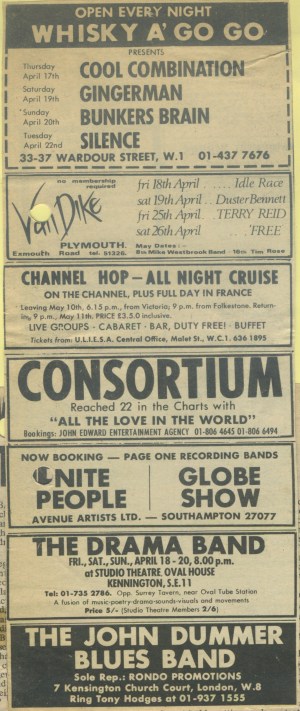
DRAMA BAND GIG

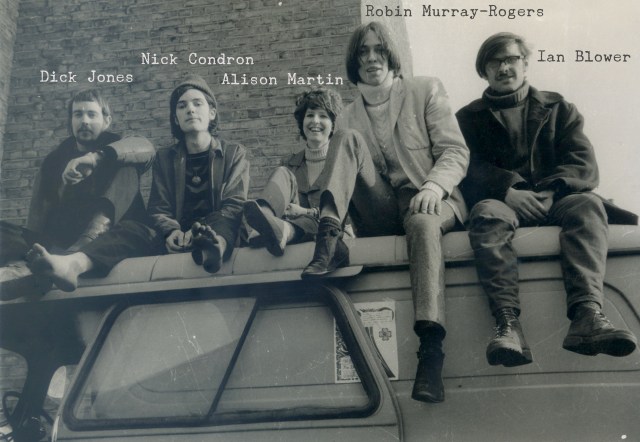
Mal’s and my best intentions concerning a disciplined theatrical structure dissolved at the outset and a period of wildly creative chaos followed. Mal swiftly opted out in favour of a sensible career in educational management and I forged ahead, high on groundless optimism. My initial musical partner was a moody but brilliant guitarist whose speciality away from the fretboard was the creation of electronic soundtracks on state-of-the-art equipment in a suite of rooms in his mother’s luxury basement flat in Kensington. His name was Nick Condron (although his subsequent alter ego, Rikki Sylvan, will be more familiar to students of the nascent New Wave 10 years later when he flared brightly but briefly). Access to Nick’s battery of electronica was a major initial stimulus in the devising of some of the more outré drama pieces with the sonic media that Nick could produce frequently dictating the content of the writing. And his angry aptitude on his blue Strat pushed the musical direction towards the much heavier sounds that were superseding the whimsical, serpentine approaches of the post-psychedelic/folk-rock stylings. Selected from the latest small ad, a second guitarist, Chris Aldous – a down-to-earth but open-minded player – joined us and with him a German émigré called Piers Delft on drums.

DRAMA BAND 1

The Drama Band at the Oval House

As Robert Browning declared, ‘Ah, but a man’s reach should exceed his grasp / Or what’s a heaven for?’ Towards whatever mixed-media heaven it actually was that we strived, we certainly specialised in the excessive grasp. Practicalities of the most basic kind impeded the realisation of the various projects that we mapped out on paper and much time was spent in our Sunday room at the Oval House in wearying doctrinal arguments about theory and practice. Our failure to locate the precise chemical formula that might bring about a successful fusion of sub-Hawkwind rock, dystopian science fiction and Brecht’s theatre of alienation, Nick Condron’s thunderous sulks and the gradual falling away of jaded personnel had us gradually sinking collectively into our own special Slough of Despond.
DRAMA BAND 2

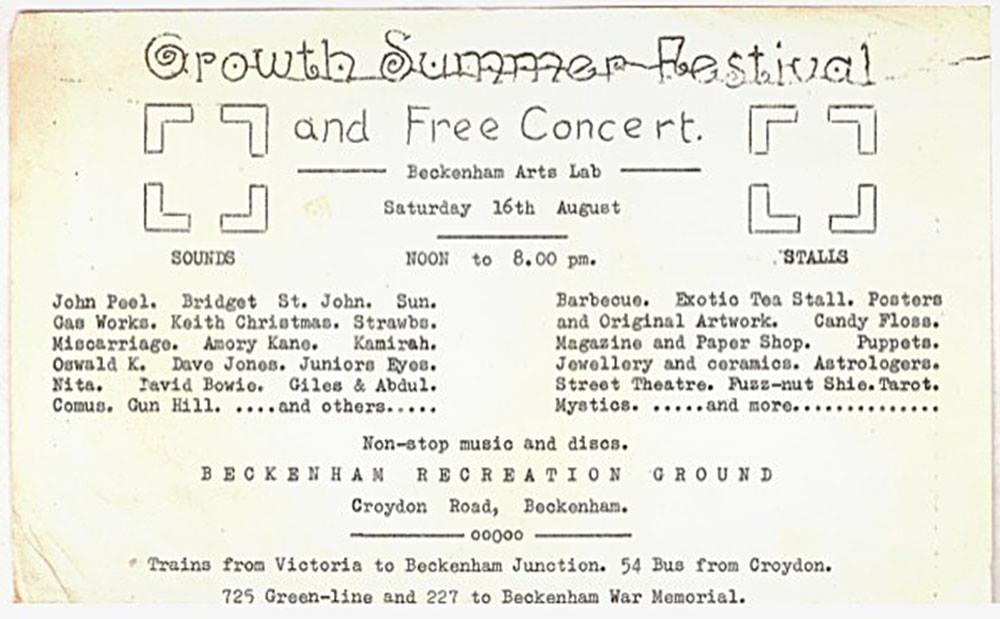
There was, however, a curious creative interlude that breathed a little final oxygen into the fast-deflating Drama Band. It came in the form of a prosaic coincidence of local geography and the intervention of a visionary young man whose own notions of cross-fertilisation between performance art forms were galvanising him into action just down the road from where I now lived. Newly married, Gez and I had only very recently moved into a tiny maisonette in Bromley, then a North Kent town of almost Stepford uniformity. It was all we could afford and it offered easy bus routes into Lewisham and New Cross and the two schools at which we were teaching. One dull household shopping Saturday a couple of barefoot girls pushed a scrappy duplicated flyer into my hand advertising a free festival in neighbouring Beckenham. Promoted by the Beckenham Arts Lab, the Growth Summer Festival and Free Concert boasted a fascinating bill of performers. Three names in particular caught my eye: John Peel, our old friend from Middle Earth days; Bridget St, John, whom I knew to be a protege of Peel’s, and David Bowie, a singer/songwriter about whose involvement in mime and theatre I’d just been reading in International Times. Clearly too good to miss both as entertainment and an opportunity for networking, we made our way over there on August 16th.

3. ARTS LAB

My recollections of the now immortalised Free Festival are clear but fragmented. With the self-indulgent reasoning of the time, we sharpened the potential experience of what was a remarkably varied and enterprising event by smoking ourselves to a standstill just before it started. But I do recall that Keith Christmas did extraordinary things with his guitar, Bridget St John delivered Autumn Lullaby in a velvet baritone voice and David Bowie wearing a shirt I’d have killed for sung several beguiling songs to a Hagstrom 12-string. A surprisingly large number of kindred spirits had found their way to suburban North Kent and in between the somewhat chaotically presented acts they watched psychedelic puppetry, bought hand-painted balloons and caught a glimpse of the future via tarot readings.

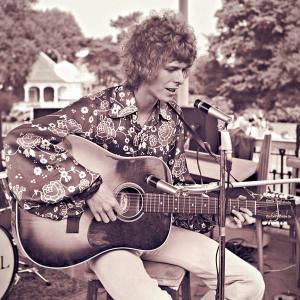
Recollection is most vivid from some time after the acts had finished and the crowds were heading for bus stops and station. Clearly etched into memory is the moment I recognised David Bowie standing alone in the evening light at the edge of the recreation ground. It was the aurora of curly hair and the magnificent shirt that once again drew my eye and since I hadn’t come across John Peel yet, I thought I’d introduce myself and find out what he might know about ‘Growth’ and the Beckenham Arts Lab.
4. BOWIE FREE FESTIVAL

David Bowie creating memories at the Free Festival.

Bowie was very easy to talk to. He revealed at the start of conversation that he was a key figure in the Arts Lab and that he and his co-organiser Mary Finnegan were on the constant lookout for new acts. Although clearly passionate about his own work, which at that time was prolific songwriting (Space Oddity had been released the previous month), he was also an interested and generous listener. I explained about the Drama Band, enhancing carefully and creatively the ratio of ideas in process to actual performance to an audience. Bowie was immediately responsive, declaring that it sounded ideal for the Lab. So I gave him my address and ‘phone number and he promised full details of the upcoming programme and any potential vacancies for an initial gig for the Drama Band. He also said that a major element in the Arts Lab process was collaborative work and that he was sure that we’d find some common ground for shared performance. I’d long wanted to incorporate mime into our repertoire, but where free interpretative dancers were all-too-easy to find, skilled mime artists were a rarity. Bowie, having done extensive mime training with Lindsay Kemp a couple of years earlier, responded readily and we parted both fired up at what might emerge from a next meeting.

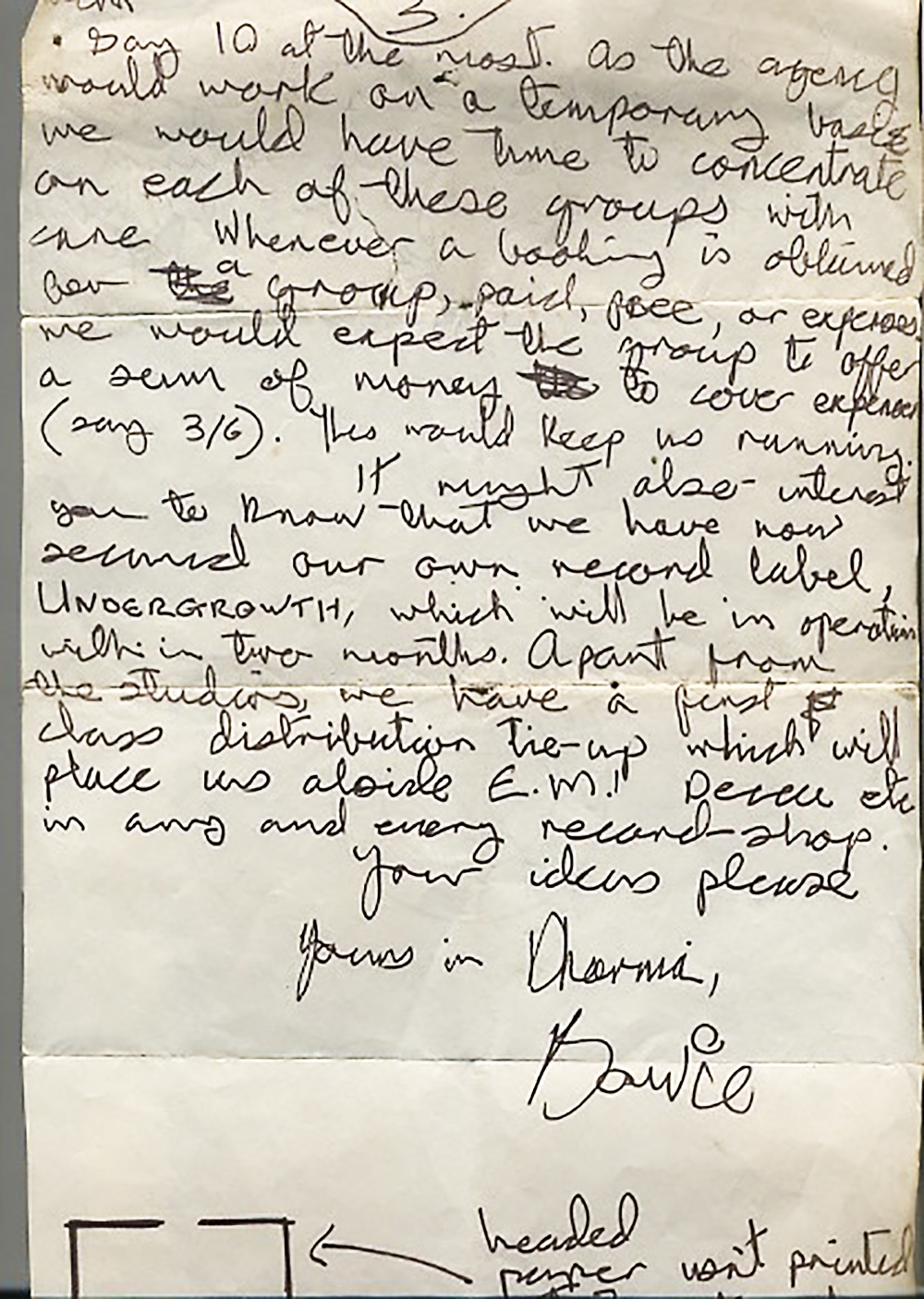
First and last page of the David Bowie letter.
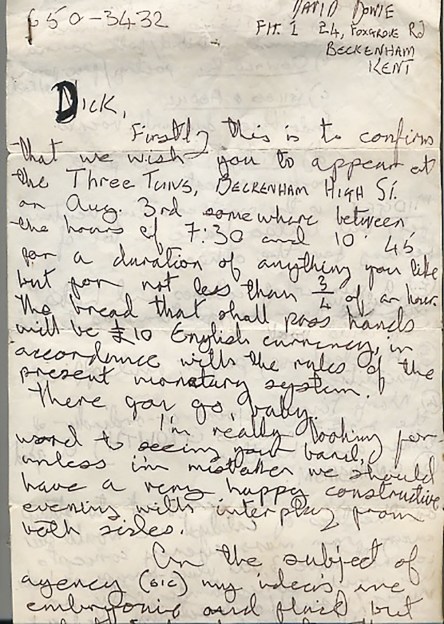
Within a few days I received a call at home saying that he was on his way over imminently. Arriving in a cluttered red Fiat 500, he played us several songs including a two-section version of Space Oddity, with the 12-string placed to one side as he solemnly keyed the tiny stylophone with its little attached metal pencil! There was much talk of the arts lab and a couple of dates were put in the calendar for a Drama Band appearance, sight unseen. Bowie sent an enthusiastic letter a day or two later confirming the booking and – thanks to this unwarranted piece of serendipity – we managed our two rickety performances, one of them supporting the man himself*.

Sadly, any hopes of our heading for the stratosphere hanging onto the fringes of our mentor’s buckskin jacket were swiftly confounded. Gathered up by the formidable Angie Barnett (later his wife, then just a very attractive force of nature), David Bowie’s career went into overdrive and along with other arts lab proteges, some of them much closer to the heart of the operation than we were, we watched the dust rise in his wake as he whirled away from Beckenham in the direction of Shangri-La.

At around this time I changed schools. Restless amongst the glue pots, milk queues and dinner duties of my cosy New Cross primary school, I decamped to a boys’ technical secondary school in the heart of unreconstructed Deptford. Whatever crusading spirit had fired me up at the beginning of the first term, it soon evaporated in the face of the day-to-day frontier realities of riot control, corridor and playground anarchy and a staffroom full of bitter and exhausted post-war-emergency-trained middle aged male teachers.

Salvation came in the form of a skinny, curly-haired English teacher straight out of university and new to South-East London. Robin Stone brought with him a restless, hyperactive energy, a cheerful irreverence for order and protocol and a passion for music. Within a week I’d drafted Robin into what remained of the The Drama Band and what followed resulted directly from the sparks that flew between us. A final summit meeting at the Oval House had Nick Condron storming out with the Marxist-Leninist wing of the party, leaving we battered anarchists contemplating the flotsam and jetsam left behind. Galvanised by Robin’s cheerful unconcern for practicalities, I spent no time mourning the demise of yet another musical venture as we sat around in his Brockley flat, wreathed in smoke, laughing a great deal and planning the next musical revolution
Posted in Uncategorized | 2 Comments