DICK JONES – THE BASEMENT TAPES 3. Tintagel

Scan

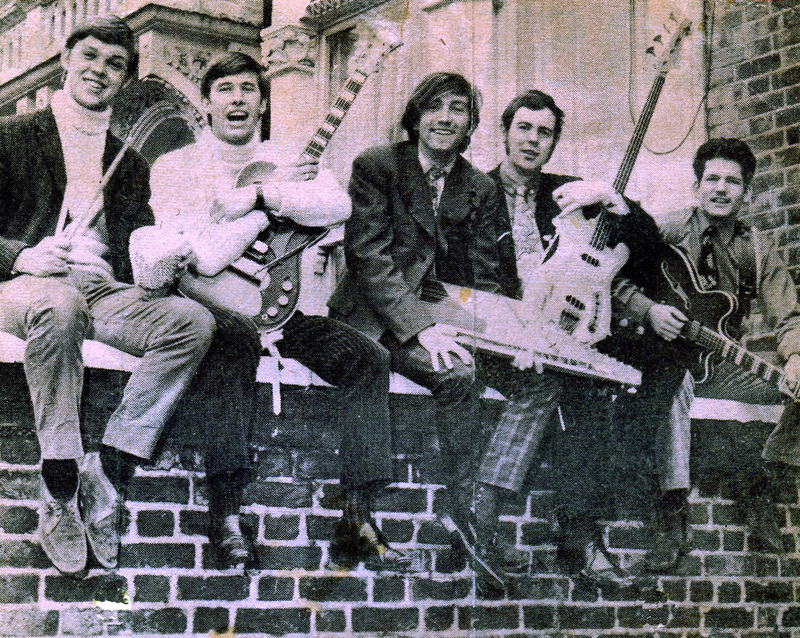
We entered 1968 with just Pete Currie, drummer Phil Burroughs and myself as original Nervous System members. From the many sides of quarto paper onto which we all wrote our choices of names, we selected ‘Tintagel’. Redolent of the Celtic Twilight/Albion mythology undertones that were such a feature of early British folk-rock-into-psychedelia, it seemed to fit the bill perfectly. By now Pete had augmented his Danelectro 12-string guitar with a sitar, both added to the now dangerously obese yet slenderly resourced HP account. (And with all due respect to the mighty Ravi Shankar, whose claim it was that even after several turns around the karmic block the most dedicated practitioner would still be a mere novice on the sitar, it takes only 20 minutes to make it sound as if you know what you’re doing. This is helped greatly if your audience has never seen one before, or if they are comprehensively stoned. Or both).

Pete, Phil and myself were living together now in modish squalor in Charlton, South-East London (think Withnail and I and magnify to the power of 10). We lived off sixpenny packets of chips and steak and kidney pies, the wrapping residue of which was skilfully fashioned into floor covering. I occupied a double bed in the front room, which I saw as an island of relative sanitary sanctuary amongst the flotsam all around. The hallway was full of amplifiers, speakers and instrument cases and inside the cupboard under the stairs an electricity meter hung off the wall, its kilowatt hours recording dials mysteriously stilled. Each weekday morning, regardless of the lateness of the previous night’s gig return, Phil and I would rise at 5.30 and drive blearily in his tiny Thames van up through the east of London to Woodford Bridge in Essex and the Victorian gothic horror that was Claybury Mental Hospital. He worked as a porter and I laboured away amongst the steaming tumblers in the laundry hall. (The bizarre tales that arose from that experience will, at some point, be told).

The band was, as ever, a constantly shifting organism. But at the beginning of 1968 Tintagel was blessed with some outstanding musicians. In front we now had two flautists/guitarists – Iain Cameron, who subsequently went on to play with posthumous wunderkind Nick Drake at Cambridge and Ian Macdonald, who subsequently went on to co-found King Crimson. The Melody Maker small ads brought us Brighton-based guitarist Jeff Matthews, whose skill and consistency helped immeasurably to both augment 12-string-string and sitar-playing Pete when he was on his highly creative game and to compensate for him when he was indisposed. So as regulars on the now burgeoning underground circuit our caché was high and our credibility sound. We were working through an agency and getting steady re-bookings. All we lacked was the two-edged benefits of management and the all-important record deal.
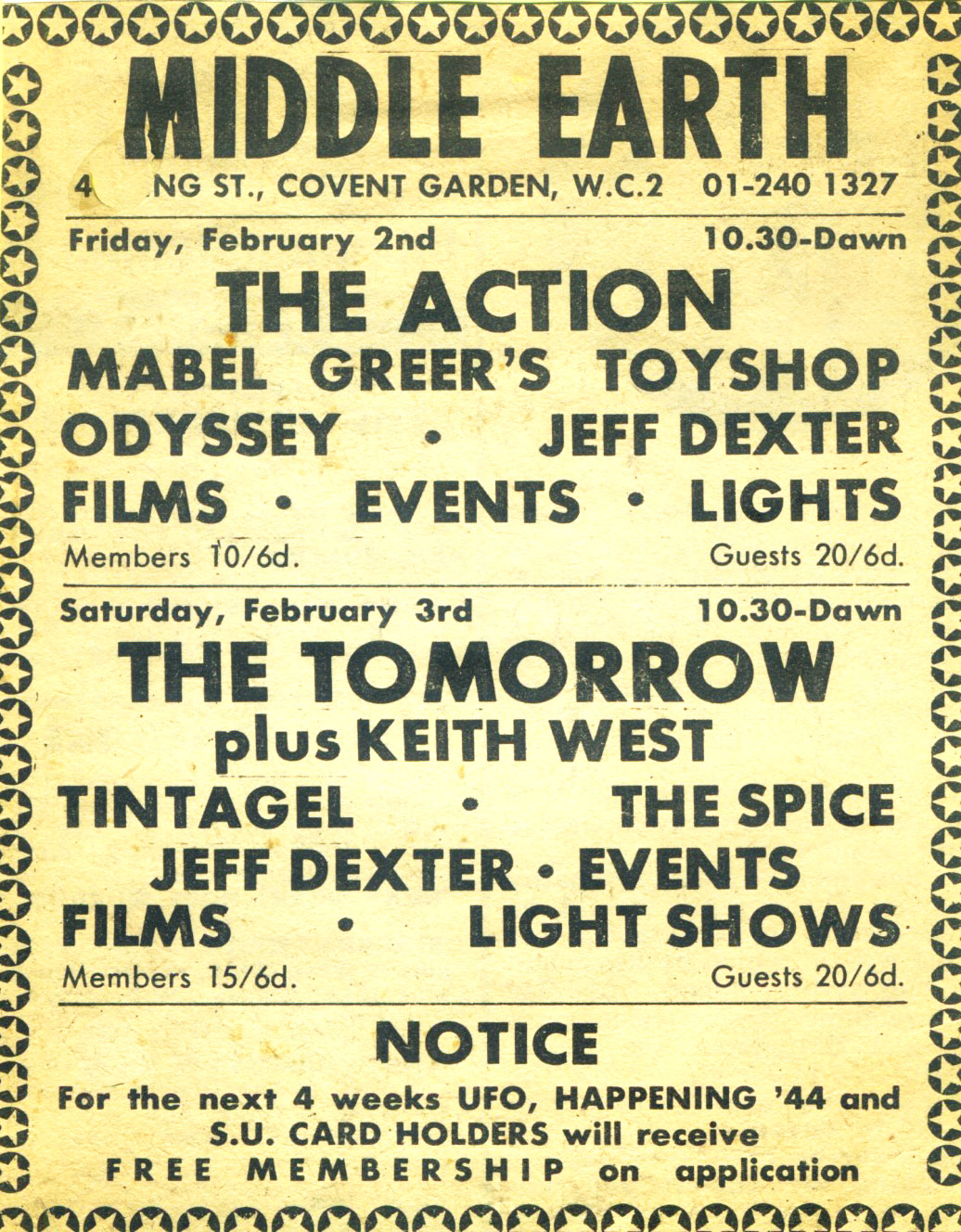
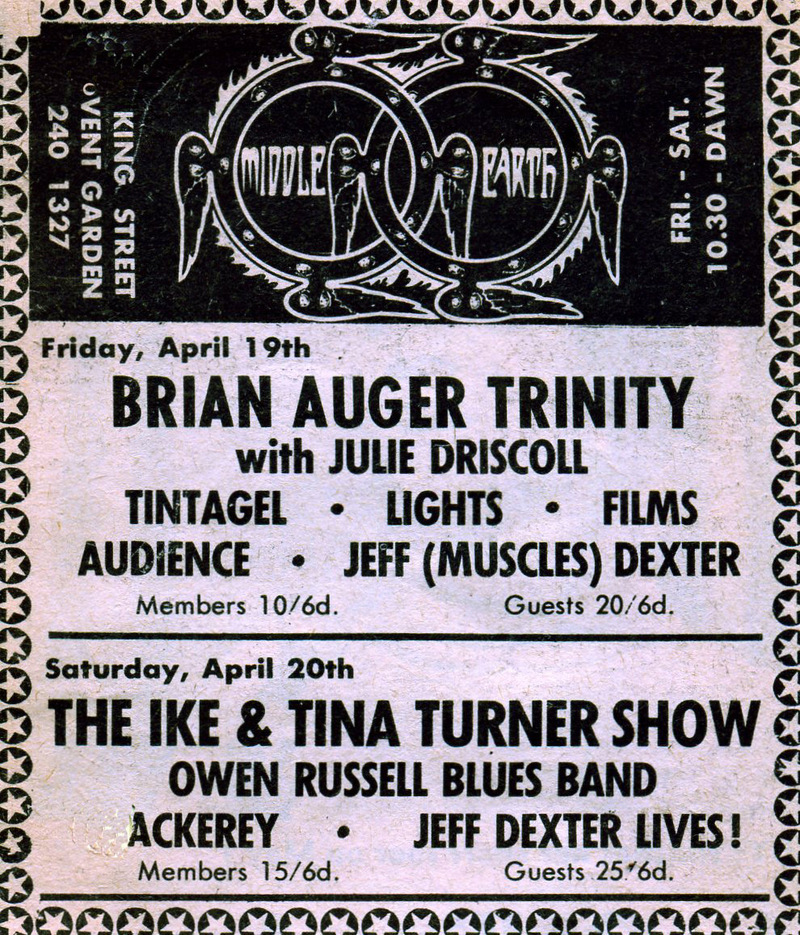
TINTAGEL ME 12. MIDDLE EARTH

1. TINTAGEL 1

In the early spring of 1968, we peaked impressively. For some time American singer Dorris Henderson had been looking for a band. She’d recorded with guitarist John Renbourne (an album recently re-released to much, very late acclaim) and was touring the folk clubs with a repertoire of traditional British/American ballads, gospel songs and blues.
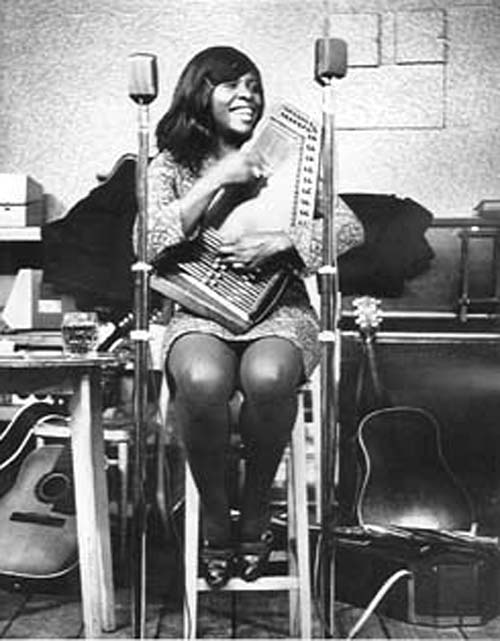
DORRIS 1

Dorris Henderson

She had been a de facto resident in the UK for some time and with the first visits from touring American gospel and blues artists still fresh in memory from only 10 years before, she had been accorded somewhat iconic status. Tiny but with a deep and powerfully soulful voice, Dorris wanted to break free from what she saw as an increasingly stifling set of musical expectations on the part of her audiences. She was tired of being the authentic voice of black American folk music – a sort of UK Odetta – and she wanted to explore the very same musical roots and shoots that were exciting us so much. With Renbourne now ensconced in the band Pentangle and the influence of the West Coast folk-rock bands still a powerful force, Dorris was looking for similar opportunities. It was our ad in the increasingly progressive New Record Mirror that caught her eye and after a meet-up and a session, we agreed to hitch up together. We were more than happy to take on much of her solo repertoire and she was excited by our portfolio of eclectic covers and original material. But it was from the start a mariage de convenance rather than a merger and for all the insouciance of the age that had us boasting of taking on a ‘chick’ singer, Dorris was calling the shots.

Three gigs, all close together, fully justified the union, helping Dorris expand her musical scope within a band context and doing us no harm at all for the distinguished association. Two of the gigs were engagements that Dorris had had in her diary for months and, because of her musical clout and strength of personality, she was able to re-negotiate both to include ‘her’ band. The first was at Bert Jansch and John Renbourne’s folk club situated in the huge Three Horseshoes pub at the top of the Tottenham Court Road. We played to a sizeable crowd and it went down well. Dorris’ driving voice sat comfortably on top of our 12-string arpeggios, our woodwind, the running, looping bass lines and Phil’s light but driving drumming.

DORRIS 3

Several members of the audience hung around as we slipped down a quick after-hours beer at the bar before shifting the gear into the van and heading south of the river. Dorris brought over a pale, rather diffident Scot and a small, dark, solemn-faced New Yorker and we found ourselves being thanked for our efforts and praised for our originality by club host Bert Jansch and his pal Paul Simon.

In early spring we fulfilled, with Dorris, one of our bookings at the Marquee in Wardour Street (a club whose minute, unsanitary dressing room has accommodated every band of subsequent note in the land.) After a storming set to a packed house we adjourned to The Ship, the nearby Marquee local. Clinging to Dorris’ arm and talking urgently as we walked the few yards up Wardour Street was a fierce lady with thick blonde hair and dark eyes. In the pub she ignored the band completely, leaning conspiratorially towards its singer and telling her – as if at that high point she needed persuading – that the future for the female vocalist was in front of a shit hot band. Within a month or so Sandy Denny was fronting our old Middle Earth regulars Fairport Convention.
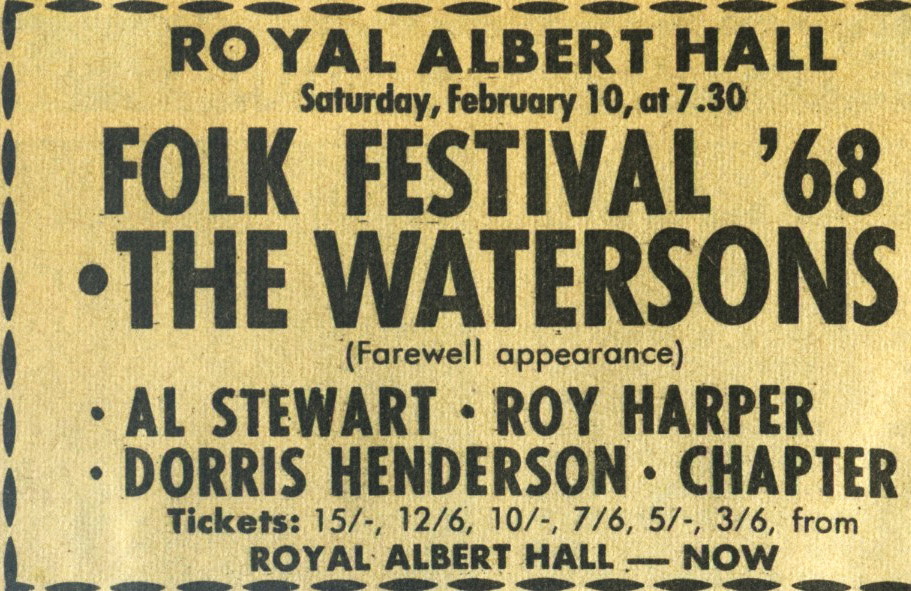
TINTAGEL ALBERT HALL

In May we played the Albert Hall. Dorris had a support spot on a packed bill for the farewell concert of folk’s first family The Watersons, splitting after relentless touring since the early ‘60s. Following a nightmare soundcheck with Phil’s bass drum echoing back off the circular galleries a half-beat late (“The night they invented ska”, muttered a miserable Phil), I paced the ornate corridors, dry-mouthed with terror as post-Dylan epic balladeer Roy Harper overran his set massively. (I bear the grudge still). We hurtled onto stage 40 minutes late, whimpering like aristos facing the guillotine. At all points of the mighty hall an audience still in post-Harper rant shock, stirring and muttering, watched us as we stumbled about the vast stage, tripping over cables and manhandling instruments that we had completely forgotten how to play. But Dorris, the consummate professional, seduced the audience within seconds and lost in the unrepeatable moment, we played our full programme impeccably. Numbers I remember from that extraordinary night included from Dorris’ erstwhile solo repertoire the folk song Watch the Stars and Jackson C. Frank’s Milk and Honey, and from our set-list Love’s Message To Pretty, Donovan’s Season Of The Witch (featuring Pete on bravura sitar) and our own White Morning (lyrics by D. Jones).

A handful of further gigs came and went and then Dorris returned to Los Angeles for a family visit. On her return, with regrets but good sense she quit Tintagel to join the fast-rising, already successful Eclection, who had management and a recording deal. Suddenly bereft of our supremely talented meal-ticket, we wobbled, recovered, lost members (notably the very talented Iain Cameron and Ian Macdonald), auditioned, gained members and tried to re-orientate as in the days before Dorris. But we’d been royally spoiled and within a few weeks we lost direction and with the compass gone that crucial sense of being ourselves alone dissolved. So with neither bang nor whimper but simply a drifting away of key components, Tintagel finally sundered at the end of the year. For the first time since Bismark’s Imperial Jug Wizards, Pete Currie and I were not on either end of a stage together. His departure to join the protagonists of the revolution in the offices of hippy broadsheet International Times pulled out the last threads of the old lineup and with the gravest of misgivings I took a deep breath and leaped into the unknown…
Posted in Uncategorized | 1 Comment

DICK JONES – THE BASEMENT TAPES 2. The Nervous System

1. NERVOUS SYSTEM 1

L. to R. Martin Fry, Dave French, Martin Fieldhouse, DJ, Pete Currie.

2. THE NERVOUS SYSTEM

By the end of 1966 the mothball smell of the demob suits began to pall, the starched collars chafed and the music now sounded conspicuously scratchy and thin. And for the vigilant zeitgeist spotter, there was definitely something in the air. From The Tony Hall Column in the New Record Mirror – a regular feature stuffed ignominiously into a two-inch column space south of the Petula Clark and Walker Brothers interviews – there was hot news of radical musical departures in San Francisco. That a group should simply be named the Jefferson Airplane, the Sopwith Camel or the Quicksilver Messenger Service was exciting enough. That the musicians wore scarves around their heads, fringed buckskin jackets and square sunglasses was indication that the revolution must be close at hand. The ever patient Chris Willard stumped up again and orders were placed with his American supplier. Within a few weeks Pete and I were working out the chords to Love’s Message to Pretty, The Crystal Ship by The Doors and – entirely unsuccessfully – Captain Beefheart’s Sure ‘Nuff ‘N Yes I Do. (What the fuck’s a ‘slide guitar’?)

In the meantime, beatnik Dave (who became our roadie long before our first down-payment on guitars and amps) had introduced us to the kind of hand-rolled cigarettes that hitherto I had only read about in jazz biographies. Following Dave’s lead, we lay in the long grass just beneath the college Chancellor’s office window, turning on and tuning in, the spring before the Summer of Love of ’67 gathered us up. Conversion was swift and comprehensive. Like Toad of Toad Hall again, my rapture for the new disorder was total and all I wanted was an indiscriminate mess of jangling 12-strings, screaming feedback, wacky lyrics and psychedelia (whatever that was) in indiscriminate spades. Nearly all of the Bismark’s crew ran for cover in the face of such wild-eyed zeal leaving Pete and I to press on undaunted. We formed a new band and went in search of the local branch of the New Jersusalem.

After spending a fortnight arguing about an appropriately outrageous name (The Flesh Knot, The Sperm Bank and Pete’s favourite, Disastrous Partridge and The Seven Year Whistle were stoned front runners for a while), we ended up as The Nervous System and began to sort out who was going to play what. Pete knew several more chords than I did and could barre all of them without getting finger cramp so I moved from guitar to bass, using a blue Selmer of Pete’s with a bent neck and a correspondingly high action. Pete, with a cavalier disregard for the real-world economic niceties of hire purchase, stocked us up with amps and a PA and suddenly we were, not a group, but a band! After a few rehearsals with three others of equal incompetence – a second guitarist, a drummer and a faute de mieux singer – an initial line-up stabilised and we shambled out onto the mile-high stage of the Knight’s Youth Club, Brockley for our debut gig.

Jingling like lost sheep, appropriately clad in our woolly Afghan coats and peering myopically through our regulation Jim McGuinn dark glasses at an incredulous audience, we proudly demonstrated our complete lack of understanding of rhythmic and melodic coordination, stage dynamics and basic electronics. With amps on overload and between-song guitar tuning sessions that exceeded in length the songs themselves, we managed to lurch through three numbers – one original and two Byrds b-sides – before an apologetic vicar asked us ever so nicely to pack it in.

Hubris without even a modicum of foundation is a great asset and over the next few weeks we persevered in the face of derision and indifference. And then our time came. Suddenly someone invented the Summer of Love and even the hardcore South-East London soul and ska hotspots went all beads and kaftans and the search was on for native folk rock and psychedelia. Instant experts, prophets honoured in their own time, veterans of three months jangling in pubs and church halls, we were in demand and a brief but intensive period of hard gigging grew us up fast.

Initially, we signed up with a Lewisham agency, South-East London Entertainments in Grove Park, from whom we received a proliferation of gigs across the Far West and the Deep South. Whether motivated by a sense of devilment or simply failing to recognise the seismic changes of the time, SELE booked us into some real hell-holes. Turning up at a village hall deep in the Wiltshire countryside, we were a little surprised to find that we’d been billed as ‘The Merva Sisters, with lights and uniforms’. What the village youth expected from this enigmatic combination can only be imagined, but the reaction couldn’t have been more extreme than the mixture of horror and hilarity that greeted our emergence from the van. Velvet loon pants, frilly-fronted satin shirts and embroidered Afghan waistcoats may have reached the streets of Swindon, but they had yet to make it as far as the fields and hedgerows. It took a bravura performance that night to get our public to switch attention from ducking-stool to dance floor.

3. NERVOUS SYSTEM AT 5 ACRES

L. to R. Dave French, Bob Meadows, DJ.

On another night at some equally bemused bucolic venue the audience benefitted from an unexpected side effect of our primitive light show. It comprised two troughs of 60 watt bulbed lights mounted at the front of the stage variously gelled up to give a colour mix. To one side of the stage an ancient slide projector was mounted, casting a swirling, constantly changing display of psychedelic shapes across the band and onto the nearest wall. These effects were obtained by squirting from a pipette a mixture of water and oil-based coloured inks into double-glazed slides, each tiny panel secured at the bottom and sides by tape and open at the top. At the best of times there was a hit-or-miss element in the procedure, but this cheerful amateurism was compounded on that night by our equally improvisationary approach to wiring. One plug too many had been crunched under foot during a post-gig get out and we’d jammed two sets of wires into one socket on the plugboard with matchsticks holding them in place. We managed to get through three or four numbers before splash-over from over-energetic water injection from the light show anointed the plugboard. Bob, our singer (an ex-Butlin’s redcoat who’d crossed over with a vengeance) sang barefoot. He was always a bit of a singing dervish and some time passed before we realised from the unusual vocal embellishments that his particularly animated performance owed more to the properties of water conductivity than the spirit of the dance.

2. HAPPENING 44

Happening 44 functioned on Thursdays and Saturdays, operating as a strip club for the rest of the week. We played it several times, benefitting from authentic Californian Ron Henderson’s Fiveacre Lights.

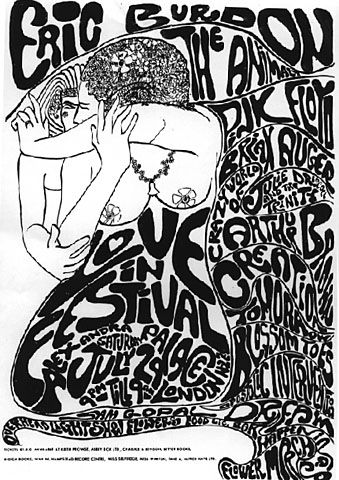
Through a combination of simply being in exactly the right place at precisely the right time and Pete’s shameless creative hustling, we soon found ourselves moving from the gobsmacked fringes to the heart of the capital, now in full spectrum London swing. Early in the game we joined the circuit of bands doing the rounds of the nascent underground clubs, always trailing in the wake of the heavyweights, spectacularly present and manifestly future. So from our humble corner of a Dionysian dressing room, we watched Syd Barrett being lifted bodily up the steps and onto the stage at the International Love-In at Alexandra Palace, his guitar hanging around his neck like the Ancient Mariner’s albatross, his mind high up amongst the thermals. We were approached after a set at Middle Earth in Covent Garden by members of Fairport Convention (who we were supporting), fascinated that we were using a traditional folk song in an electric format, something they’d been considering. At the same club, we gathered up a shy and unrecognised John Peel at 3 am and bought him a steak pie in the busy market, surrounded by bemused porters at early breakfast. At Chiselhurst Caves Eric Burdon roared so mightily into the two mics we lent him in quick succession that we had to bin them and buy new ones. And cradling our precious guitars like sickly children, we watched (again at Middle Earth) a distinctly unmellow Denny Laine slam his Rickenbacker repeatedly against the wall in reaction to a malfunctioning amp.

5. INTERNATIONAL LOVE-IN JULY '67

The International Love-In Festival at Alexandra Palace (venue of the earlier and more celebrated because  pioneering 14-Hour Technicolor Dream), staged in July 1967 was a spectacular event. We closed the whole glorious shambles as the sun rose over North London. Before us lay like the newly slain the slumbering forms of our audience.

The summer of 1967 seemed to go on forever. We began it as The Nervous System, a college band that got lucky, and we closed the year as Tintagel, thoroughly gigged, half-competent and twice as arrogant (although, of course, in a loving and peaceful sort of way).

Posted in Uncategorized | 7 Comments

DICK JONES – THE BASEMENT TAPES 1. Bismark’s Imperial Jug Wizards.

EXCUSES…

One of the most engaging aspects of running a personal blog is the way in which it provides for a mixture of private meditation and public grandstanding. At whim, the blogger can share sober reflection or indulge in immoderate ranting. S/he can offer modest advice and tentative wisdom or reminisce interminably and flash a wallet-load of family snaps with all the tact and grace of a maudlin drunk in a bar. And best of all there’s no editor at the business end to spike the story!

Pushing 15 years ago now, I posted to my old blog a chronological account of my long involvement in the playing of music, from student days in the ‘60s up to the present. My original intention had been to provide something brief and downbeat concerning the fag-end of the rock-and-roll dream – the reality of crap gigs, broken-down vans, cynical promoters, vainglorious ambitions and preposterous aspirations. But as soon as I got started and the memory gears engaged I recognised in the moment, as I did way back when, that there’s a price for everything. Night after night of manhandling a bass amp up flights of stairs and then back down again with the summer sun not long set or in the winter rain; the built-in bullshit of agents complementing the built-in treachery of managers; the drunk’s insistence at the end of the night that he can play the drums like Ginger Baker; the single-minded, self-serving ambition of the brilliant lead guitarist who jumps ship for a faster vessel two days before that clincher gig… All of this and so much more is the tax imposed for an hour of glorious immersion in the music and the tidal roar of an audience that really gets it.

So in between the remembering and the writing, it all turned out rather differently…

DICK JONES – THE BASEMENT TAPES

The physical creaks and cracks of advancing age taken into account, it’s clear that a heart has grown old when its host accepts that the dreams and visions of youth will never be fulfilled.

Some of us, however, never quite attain that level of sober maturity and we remain uncertain into dotage as to what we’re going to be when we grow up. I still hanker occasionally for a life on the footplate of a speeding steam locomotive, or at the controls of a Spitfire sweeping low over the White Cliffs of Dover.

But my one great undiminished ambition, nurtured from early youth, has always been to play music for money. ‘Fun & profit’ was the rallying cry through successive bands jockeying for position amongst all the other contenders scrabbling at the foot of the ladder. Let this be what pays the bills!

So I became a teacher. The weight of bourgeois expectation, the assumptions of a middle class upbringing in post-war Britain, the simple practical need to put food on the table for the family and pay the mortgage dictated the sensible course. While others still struggled up and down the motorways wedged between the drum kit and the PA in a Ford Transit belching smoke, I knocked off work at 4.00 and returned home to mark books.

Well, actually, not quite. Lacking the strength of mind, or plain unselfishness, to slip the bass guitar under the bed, I continued to pursue the dream as if what happened between 9.00 & 4.00 was itself the fantasy. And, with the wisdom of hindsight, there’s little doubt that, over the years, home and family paid the price.

Between 1965 & 1990 I ricocheted from one musical venture to another, driven by the urgent need to locate musical territories largely unoccupied by others. The search was always for the unexplored genre, or at the least a degree of authenticity lacking in those already exploring it. Finally the accumulation of alarms and diversions that come with middle-aged parenting slowed the momentum down to a once-in-a-while gig. And then, just to compound the stalling of the dream, I started the whole cradle-to-classroom thing all over again with a second family! Only now, at a time of life when a modicum of dignity, decorum alongside physical dereliction might have been expected to hold sway, did I finally find the opportunity to achieve a little equilibrium between the music and the real world. Retirement – taken a tad earlier than absolutely necessary – and my very good fortune in renewing two crucial musical links from the dim and distant brought it about. But more of that later. Where did it ll start..?

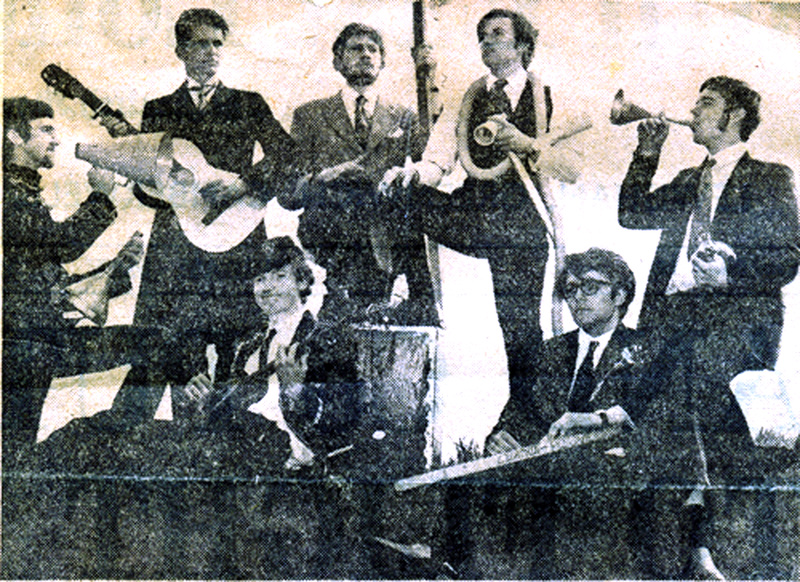
1a_bismarks_1_copyL. to R. Mal Griffin, Pete Currie, Sam Hodson, Dick Hughes, Colin Oliver, Jon Richards DJ.

                                  1. BISMARK’S IMPERIAL JASS/JUG(G) WIZARDS

1965 was a strange year for the jeunesse d’oree at the cutting edge of fashion. The Beatles and Stones had been in place for a couple of years. Other groups had moved onto the block and were challenging their supremacy. The world of commerce was now taking an active interest in street culture and couture. The mod minority was now the catalogue-and-chain-store majority.

Mal Griffin and I were Drama students at Goldsmiths’ College in South-East London. We were cocky, arrogant and pissed off that in our tonik suits and tab-collar shirts we were pretty much indistinguishable from any 50 other mardy lads just out of school who considered themselves at the cutting edge. So we took to spending our Saturday mornings sifting through the contents of the battered barrows that clogged the length of Douglas Way, an annexe of the historical Deptford Market along the High Street.

This was the era of the drip-dry shirt and off-the-peg suit and it was also only a decade since the first wave of West Indian immigrants had arrived on the Empire Windrush. The market barrows were elbow deep in pre-war striped collarless cotton shirts and boxes full of the stiff, starched collars that attached to them. Dangling from hangers beneath the canopies were rows of blue, brown and grey pin- and chalk-striped double-breasted suits, the jackets full skirted & the trousers high-backed and front-pleated, the legs flapping like sails from their deep pockets down to their one-inch turn-ups. And fluttering amongst them like exotic birds were the massive spatulate ties, big as trowels, of the Jamaicans and Trinidadians – the height of fashion in Kingston and Port-of-Spain, but dumped in a rush in favour of attire more acceptable to conservative and largely prejudiced employers.

At 2/6d a shirt and 10 shillings a suit (12.5 & 50 pence respectively), there was still enough left in our student grants to ensure fags and beer. So Mal and I abandoned our Fred Perry casuals and our knuckle cord hipsters for three-piece demob suits, Edwardian shirts and collars and technicolor ties depicting sinuous naked ladies, tropical flowers and parrots in full cry.

All that we lacked in our splendour was a context. Sitting amongst our fellow students in the refectory we simply looked like extras from a period film set on a coffee break. We needed a setting, a platform for our costumery.

Cometh the hour, cometh the band! Word reached us that at the Tiger’s Head in Catford – a brash ‘30s pub with a function room – a wild and surreal art school outfit called the Bonzo Dog Doodah Band was appearing every Friday night. Fronted by the debonair (and now late and legendary) Vivian Stanshall, they played a beguiling mixture of between-the-wars novelty numbers and self-written material, these played on the standard instruments of the ‘20s dance band and interjected and interspersed with dada-cum-cabaret-cum-vaudeville routines. And all the members of the band wore impeccable swing-time tailoring.

NUMBERS LISTAn early list of numbers. (The ‘Gwyneth’ referred to in brackets is Gwyneth Powell, later headmistress of Grange Hill).

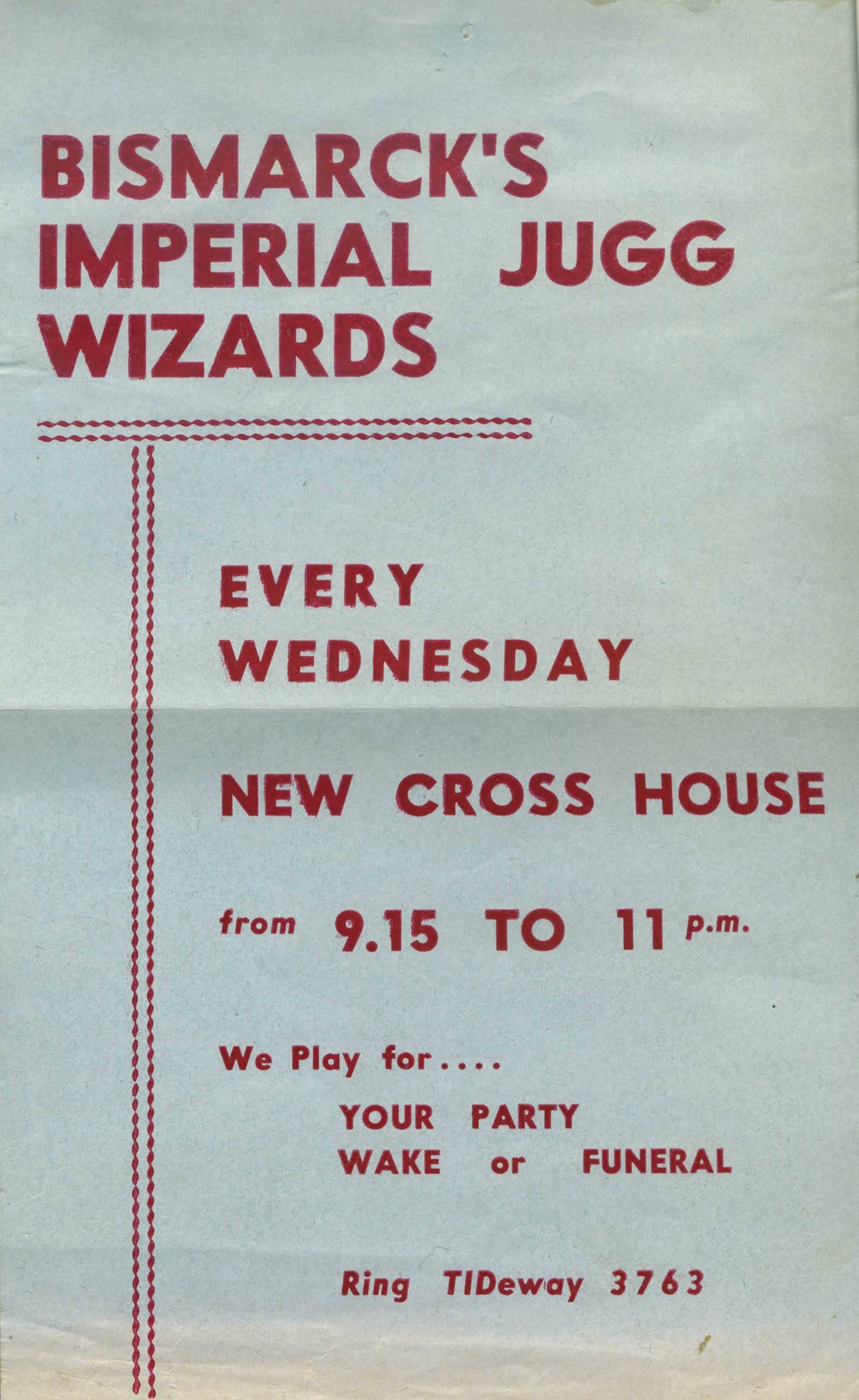
We were simultaneously seduced and inspired and from a synthesis of our sartorial indulgences and a shared love of pre-war popular music, we formed Bismark’s Imperial Jass (later Jug) Wizards. Lacking both the expertise and the instrumentation of the Bonzos, we went in the direction of the American jug and skiffle bands of the Deep South and our set included breakneck versions of such classics as Digging My Potatoes, Stealing and I’m Satisfied With My Gal. In those days before easy access to music of all genres we were very fortunate in having Chris Wellard’s jazz record shop sited exactly between the main doors of Goldsmiths’ and the college pub of preference the New Cross House. Chris stocked not just jazz releases from the States, but a range of American blues and folk records on the Vanguard, Folkways and Elektra labels so the proportion of our grants that didn’t get turned into Guinness next door went the way of those wonderful thick cardboard-sleeved LPs. Chris Wellard was obliging to a fault, delighted that amongst the rugger-bugger boozers and the pious geographers there were two kids in fancy dress who knew what they wanted in the way of imports from the States.

BISMARK'S

Mal and I drafted in a guitarist (Pete Currie, later to play a key role in the transition from rattlebag acoustic to full-on electric) and a banjo-player and then relied on a core of kazoo-blowing and washboard-bashing fellow drama students who made up in energetic self-promotion what they lacked in musical aptitude. We got ourselves a Sunday lunchtime residency at the New Cross House and enjoyed to the limit our slightly prolonged 15 minutes of local fame. Our zenith there (which preceded by only one Sunday our demise) was undoubtedly the moment when, at the conclusion of our barnstorming version of Blind Blake’s Black Dog, an enormous black Labrador burst through the double doors of the saloon bar and set about ravaging our washboard player.

Bismark’s was always more of a platform for Mal and my stylistic indulgences than it was a serious musical venture. But within its short lifetime I discovered my metier. DJ as poet, novelist, actor, director (why not all four?) – the old dreams evaporated like steam. Poop-poop – I was going to be a musician! So when Bismark’s ran out of creative fuel, I was ready to rock…

Posted in Uncategorized | Leave a comment

DICK JONES: THE BASEMENT TAPES – an introduction…

THEN..

DJ NOW DICK JONES – THE BASEMENT TAPES

40 YEARS BELOW STAIRS IN ROCK & ROLL

Forty-plus years separate these two photographs. The first was taken within the bombed remains of a church off Tooley Street in London Bridge as part of a batch of publicity pics for a band, which, at that point, was more a shared fantasy than a seasoned reality. I had only a couple of weeks before become a bass-player for no better reason other than that Pete Currie owned both a red Hofner ‘Colorama’ electric guitar and a blue Selmer ‘Artist’ bass guitar and he wanted to stand at the front playing the former as we evolved triumphantly from college jug band to rock and roll phenomenon. Struggling anyway with moving from root to barre chords at speed and suffering still from flying plectrum syndrome (whereby the inexpertly gripped plectrum played on the downstroke is fired over the shoulder at high velocity), I yielded to the principle of six-strings-good-but-four-strings-better and became The Nervous System’s bass guitarist…

:::

Over the next few weeks I’ll be posting to my blog an account of those four-and-a-bit decades. Expect self-indulgent, name-dropping  with walk-on parts taken by the likes of Sandy Denny, Dorris Henderson, Bert Jansch, Paul Simon, John Peel, David Bowie, Elvis Costello and various blues legends, living and deceased). Over-decorated with the fine lacework of unnecessary detail, it’ll be the equivalent of the pub tale that goes on too loud for too long. With the crucial difference, of course, that here you can slip into the next bar and I’ll be none the wiser!

But for most of us born this side of the Second World War, our lives and times, personal and contextual, are set to a soundtrack that starts in childhood with the uninhibited fever of early rock’n’roll and continues with whatever synthesis of words, melody and rhythm that moves hearts and feet collectively today. So if a sequence here or an anecdote there brings across a little of the atmosphere of time, place and incident then that will be gratifying indeed. But in the final analysis it’s my own desire to track the ‘long strange trip’ from remembered past into active present that drives the story. And that, I guess, is reason enough…


Posted in Uncategorized | 1 Comment

little_lamp_in_dark_room

                                                           INSOMNIA

Sleep that knits up the ravelled sleave of care. The death of each day’s life, sore labour’s bath. Balm of hurt minds, great nature’s second course. Chief nourisher in life’s feast.
MACBETH

Night falls. It bellies up to windows, crowds
the house. Da capo – dancing blind again.
Or stuck in a lift, trapped in a mineshaft,
premature burial. A hood, a mask, a carbon
lens across the eyes. A brush with oblivion,
I mutter, cotton-mouthed and bitter. Sleep
is a secret whispered to everyone else;
I’m kept in the dark.

Then cries from your cradle: birdsong,
catcalls – you have a menagerie in your throat.
I stumble down the stairs and find you caught
between solstice and equinox with a pulse
beating behind your eyes. I hold you tight
and draw your dream into my bright darkness.

You smile and, turning in my arms once,
you spill sleep like a benediction. The cipher
cracks. My darkness has no name.
I slide between its sheets.

Posted in Uncategorized | Leave a comment

CARPE DIEM QUAM MINIMUM CREDULA POSTERO.

8241999-carpe-diem-escrito-en-la-arena-con-wave

I wish I could do that – seize the time and place no trust in tomorrow. Difficult, though, when that stubborn illusion of personal immortality that gets one through childhood and youth finally yields to a sense of timespan and fragility.

And yet, between the jumping-at-shadows bouts of vulnerability when a sudden awareness of the body’s incapacities against the vitality of the consciousness bring gloom, I can still take heart. Yes, I keep forgetting names (and I understand that this is where the mental dereliction begins), but I can think and feel as passionately as ever. Age appears not to have significantly diminished what my headmaster described in the 17-year-old me as ‘an overbalanced sense of justice’. And a powerful sense of a spiritual dimension remains firmly in place alongside a quiet certainty that there is no God. I take great pleasure in the company of my friends; I laugh a lot; I read constantly; I’m writing steadily again; music, in the playing and the listening, continues to excite and move me in equal measure; and I am aware each day that I have much loved family immediately about me or close enough to see and/or hear whose years cover the spectrum from the horizon right up to a shoreline not so very far away from where I stand.

I am old enough to see how little I have done in so much time, and how much I have to do in so little.
Sheila Kaye-Smith.

[We] get to think of life as an inexhaustible well. Yet everything happens only a certain number of times, and a very small number, really. How many more times will you remember a certain afternoon of your childhood, some afternoon that’s so deeply a part of your being that you can’t even conceive of your life without it? Perhaps four or five times more. perhaps not even that. How many more times will you watch the full moon rise? Perhaps twenty. And yet it all seems limitless.
Paul Bowles

“t’s being here now that’s important. There’s no past and there’s no future. Time is a very misleading thing. All there is ever, is the now. We can gain experience from the past, but we can’t relive it; and we can hope for the future, but we don’t know if there is one.
George Harrison

Therefore do not worry about tomorrow, for tomorrow will worry about its own things. Sufficient for the day is its own trouble.
Matthew 6:34

There is only one day left, always starting over: It is given to us at dawn and taken away from us at dusk.
Jean-Paul Sartre

The word “now” is like a bomb through the window, and it ticks.
Arthur Miller ‘After the Fall’)

It is never too late to be what you might have been.
George Eliot


Posted in Uncategorized | 7 Comments

Sore Nature’s Balm 3

Sleep won’t let me in. From 23.15 to 02.20, a great weight of tiredness, moments of consciousness drift & then there’s the moonlight again. Weirdly, the brightness in the corners of the room is a small comfort. Something atavistic, maybe, from a time when nights were total darkness. I’m strangely alert now, but as the Thane of Cawdor says, it’s ‘sleep that knits up the ravelled sleeve of care’, & when the alarm goes off in 3 hours & 20 minutes, unless sleep does let me in, even if only for a brief, leg-juddering few minutes at REM level, then unravelled I shall be!

Time to lie down.

Posted in Uncategorized | Leave a comment

SORE NATURE’S BALM 2.

The time right now is 03.53. Apart from about 30 minutes of deep sleep between 23.45 and 00.15, to all intents and purposes, I haven’t slept since. When I awoke suddenly at 00.15, it wasn’t to the convulsive leg movements of PLMD (which normally occur in deep REM sleep after 60 to 90 minutes of initial sleep): I simply woke up. I then lay awake with thoughts and tune fragments drifting through my mind, as is pretty much standard process with my sleeplessness. The thoughts are not anxiety-driven; they’re generally clear and sequential, alternating between what strategies I might best use to get back to sleep and memory fragments from the preceding days.

After what I assumed to be at the most 30 – 40 minutes of tired but consistent wakefulness, I checked the time. It was 01.35. Somehow 1 hour 20 minutes had passed. It seemed inconceivable that I’d been lying in the same sleep-promotion position, awake and mentally active for so very long. Presumably I must have dozed off, but I had no sense of having passed from clear consciousness through light sleep and then back into the sequential thinking and the earworm tune as a murmurous soundtrack behind it all.

Since 01.35 I’ve been completely conscious – tired (so tired after nearly two months of disrupted sleep), but alert. I’m calm and philosophical about another night during which sleep – sore nature’s balm – has eluded me. But I am concerned about these strange holes in nocturnal time, periods during which I was either effectively asleep, albeit so lightly as to have been completely unaware of any transition between states, or, more alarmingly, awake but made subject to some unaccountable looping of time bringing about a greatly accelerated sense of its passing.

Tonight’s sleep-deprivation experience has been a sort of augmented insomnia, unconnected to my sleep disorder, which enables sleep but interrupts it. The standard process for me – inasmuch as there is any kind of pattern to it thus far – is an hour or so of sleep at a time alternated with leg convulsions that wake me up and will only abate after physical exercise and/or a period of full wakefulness in bed. A good night is one in which I fall asleep quickly after the necessary therapy. Straightforward insomnia is much less common; tonight’s experience of ‘time-slip’ insomnia is, I believe, a first.

I’m ringing the surgery tomorrow morning (more accurately, in about 3 hours) to get a referral for a consultation with a sleep specialist at a local private hospital. Hopefully, in essence the disorder will prove to be relatively straightforward. Having experienced Restless Leg Syndrome in youth and early middle age, I’m assuming that my PLMD is what is termed ‘primary’, as opposed to ‘secondary’, which would indicate some underlying disorder. (My health anxiety issues are very much tied in with fears of conditions relating to extreme morbidity or mortality). Until some programme is in process I shall continue to record my experiences here on the blog, elective access to which is available via Facebook.

It’s now 04.54. I’ll go back to bed, but it’s very unlikely that I’ll fall asleep now. The day ahead will be difficult: the general disorientation and dislocation caused by the effective merging of one day into another without sleep in between is something of a struggle. I don’t have the option of napping during the day because, as during the night, when I hit REM sleep the PLMs begin. So tonight I have to hope for, at worst, a resumption of the hour-long alternations of sleep and leg convulsions with a swift dropping off after each enforced full awakening. And at unlikely best a resumption of the full night’s sleep free of PLMD that the clonazepam gave me up to the tolerance that so suddenly came about early in August.

And so to bed…

Posted in Uncategorized | 2 Comments

SORE NATURE’S BALM 1.

A persistent tugging in the right leg has me awake after an hour. A circuit or two of the house fails to release the spring and I lie in bed again with the coil of muscle tightening and then twanging in release. Reuben comes stumping upstairs, also awake but anxious from the thoughts that stalk about in the dark. So 35 minutes on I’m sitting by his bed waiting for his breathing to deepen and extend in that steady train-on-the-track rhythm so hated by the insomniac lying awake beside a sleeping partner.

Which now it has. Alone again. Back upstairs to fall asleep the other side of the lost hour or to lie in the nearly new moonlight with that leg-spring coiling and releasing every 8, 10, 12 seconds. 

Two goodish nights behind. Enough sleep investment to soak up the hours to be lost tonight?Or will the leg, now diverted, unwound, give me a couple more hours before it loosens its newly wound up clockwork (ironic noun) to whir back into life again within 2 or 3 hours?

And so, an hour after waking, to bed…

Posted in Uncategorized | 2 Comments

LA LOTTA CONTINUA…

anti-anarchism1

If I have ever adhered to any kind of faith it’s been to a belief based on hope against rational expectation that the capacity for redemption and salvation is a product of human desire and will alone. And once that faith fuelled a conviction that the only political system within which we might grow towards our hitherto almost entirely unrealised potential was anarchism. Now the black-and-red flag is a poor, tattered thing and I oscillate between reluctant cynicism and sudden bursts of unwarranted optimism brought on when some event, local or beyond, seems to confirm the human spirit as more generous, self-sacrificial and loving than it is venal, selfish and full of hate.

There are very few certainties in my scheme of things. (In fact, to my perception there is very little scheme of things at all!) But one judgement that time has substantiated for me again and again is that wherever power is concentrated beyond the moderation of those over whom it is wielded there will be corruption and abuse. This is no dynamic insight; it is not the painfully wrought product of some intense internal Socratic debate. It’s a simple and constantly reiterated axiom acknowledged by all. But because I live in the ‘real world’ of legitimised greed, of souls mortgaged to consumerism, of programmed stimuli and conditioned responses, of institutionalised injustice, I no longer believe in some great political epiphany that will have us shrugging off our willing chains in favour of the anarchist dream. Like you, I compromise; as with you, my actions deny my principles daily; as with you, instinct and emotion govern reason and, all too frequently, moral lethargy dictates my actions and reactions.

But the radical voice is never silent – quiet to the point of near inaudibility at times, but never entirely silent. And it utters those immortal words whose synthesis of sly wit and raw truth has anarchism putting the Zen into politics: Be realistic and demand the impossible. Just about every social, political, cultural, spiritual, philosophical, biological, physical, chemical, medical, technological advance was impossible until necessity brought it into being. If there is any ‘WHY’ driving the great existential engine of ‘WHAT’ and ‘HOW’ then it’s all about a.) making the inconceivable conceivable, and b.) turning the mastered concept into action.

So deep down my faith in the very best we can be and the very best we can do never quite founders. Every time I am made aware of some infinitesimal act of self-sacrifice – the motorist in packed traffic who waves me into the space in front – or some mighty act of self-immolation – the firefighter who turns at the bottom of the stairs and climbs back into the burning tower against the deluge of fleeing humanity – I know that we have it within us to step beyond the self-crippling power systems whereby we surrender up personal responsibility to the exploiters. Reflect in this moment on how far we have stepped from slavery and serfdom to this place here and now. Why, at this point in the development of humankind, do we have to stand still?

A month or two back, I came across a little notebook that I’d begun to compile back in the mid-‘70s. It contained gleanings from a wide variety of sources and times, all of them concerned with political dissent, opposition, notions of freedom and self-government. What struck me forcibly as I skimmed through them again was how little both the nature of repression and the constant renewal of aspiration have changed. Here are some.

To be governed is to be watched over, inspected, spied on, directed, legislated, regimented, closed in, indoctrinated, preached at, controlled, assessed, evaluated, censored, commanded; all by creatures that have neither the right, nor wisdom, nor virtue… Government means to be subjected to tribute, trained, ransomed, exploited, monopolised, extorted, pressured, mystified, robbed; all in the name of public utility and the general good. Then, at the first sign of resistance or word of complaint, one is repressed, tined, despised, vexed, pursued, hustled, beaten up, garrotted, imprisoned, shot…sold, betrayed, and, to cap it all, ridiculed, mocked, outraged and dishonoured. That is government, that is its justice and its morality.
PIERRE-JOSEPH PROUDHON (father of modern anarchism – 1840)

My good people, things cannot go well in England, nor ever shall, till everything be made common, and there are neither villains nor gentlemen, but we shall all be united together, and the lords shall be no greater masters than ourselves.
JOHN BALL, (renegade priest and ideologist of the Peasants’ Revolt, 1381)

Commons to close and keep,
Poor folk for bread to cry and weep,
Towns pulled down to pasture sheep;
This is the new guise.

Envy waxeth wondrous strong,
The Rich doeth the poor wrong,
God of his mercy suffereth long
The devil his work to do.

The towns go down, the land decays,
Of corn fields, plain lays,
Great men maketh nowadays
A sheepcote in the church.
ANONYMOUS POEM (early 16th century)

LEAR:
Poor naked wretches, whereso’er you are
That bide the pelting of this pitiless storm,
How shall yourn houseless heads, and unfed sides,
Your loop’d and window’d raggedness defend you
From such seasons as these? O I have ta’en
Too little care of this: take physic, Pomp,
Expose thyself to feel what wretches feel,
That thou mayst shake the superflux to them,
And show the Heavens more just.
WILLIAM SHAKESPEARE (‘King Lear’, c. 1603/1606)

Necessity is the plea for every infringement of human freedom. It is the argument of tyrants; it is the creed of slaves.
WILLIAM PITT THE YOUNGER (1759 – 1806)

Listen, O Daughters, to my voice. Listen to the Words of Wisdom.
So shall you govern over all; let Moral Duty tune your tongue.
But be your hearts harder than the nether millstone…
Compel the poor to live upon a Crust of bread, by soft mild arts.
Smile when they frown, frown when they smile; and when a man looks pale
With Labour and abstinence, say he looks healthy and happy;
And when his children sicken, let them die; there are enough
Born, even too many, and our Earth will be overrun
Without these arts. If you would make the poor live with temper,
With pomp give every crust of bread you give; with gracious cunning
Magnify small gifts; reduce the man to want a gift, and then give with pomp.
Say he smiles if you hear him sigh. If pale, say he is ruddy.
Preach temperance: say he is overgorg’d and drowns his wit
In strong drink, tho’ you know that bread and water are all
He can afford. Flatter his wife, pity his children, till we can
Reduce all to our will, as spaniels are taught with art.
WILLIAM BLAKE (from ‘Vala or the Four Zoas’ – 1797).

Yes! To this thought I hold with firm persistence; the last result of wisdom stamps it true: he only earns his freedom and existence who daily conquers them anew.
JOHANN WOLGANG VON GOETHE (from ‘Faust’ – 1828/9)

All things are sold: the very light of heaven
Is venal; earth’s unsparing gifts of love,
The smallest and most despicable things
That lurk in the abysses of the deep,
All objects of our life, even the life itself,
And the poor pittance which the law allows
Of liberty, the fellowship of man,
Those duties which his heart of human love
Should urge him to perform instinctively,
Are bought and sold as in a public mart
Of undisguising selfishness, that sets
On each its price, the stamp-mark of her reign.
Even love is sold…
PERCY BYSSHE SHELLEY (from ‘Queen Mab’ – 1813)

Those who expect to reap the blessings of freedom must, like men, undergo the fatigues of supporting it.
THOMAS PAINE (1707)

THE TOLDPUDDLE MARTYRS

God is our guide! from field, from wave,
From plough, from anvil, and from loom;
We come, our country’s rights to save,
And speak a tyrant faction’s doom:
We raise the watch-word liberty;
We will, we will, we will be free!

God is our guide! no swords we draw,
We kindle not war’s battle fires;
By reason, union, justice, law,
We claim the birth-right of our sires:
We raise the watch-word liberty;
We will, we will, we will be free!!!
GEORGE LOVELESS (one of the group of Dorchester labourers, The Tolpuddle Martyrs, who were sentenced to seven years transportation for joining a union – 1834).

Freedom has a thousand charms to show
That slaves, howe’er contented, cannot know.
WILLIAM COWPER (from ‘Table Talk’ – 1856)

Overgrown military establishments are under any form of government inauspicious to liberty, and are to be regarded as particularly hostile to Republican liberty.
GEORGE WASHINGTON

MOURN NOT THE DEAD

Mourn not the dead that in the cool earth lie –
Dust unto dust –
The calm, sweet earth that mothers all who die
As all men must;

Mourn not your captive comrades who must dwell –
Too strong to strive –
Within each steel-bond coffin of a cell,
Buried alive;

But rather mourn the apathetic throng –
The cowed and the meek –
Who see the world’s great anguish and its wrong
And dare not speak!
RALPH CHAPLIN, Industrial Workers of the World activist

The love of liberty is the love of others; the love of power is the love of ourselves.
WILLIAM HAZLITT, English essayist

THE IDEA

Is that we are not perfect
Nor perfectable.

Is that the desire to lead
Will destroy ourselves and others.

Is that when we act alone
It is harder to harm.

Is that when we act collectively
We must not surrender our selves.

Is that land cannot be owned
Nor animals nor people.

Is that money is meaningless
When there is no property.

Is that we disavow marriage.
It is the union of Church and State.

Is that no human is sovereign
The one over the other.

Is that our children are
The common wealth.

Is that there is no god
Nor heaven nor hell.

Is that only we can be the creators
Of paradise on earth.

ANONYMOUS. (19th century Spanish anarchists called their beliefs The Idea).

THE INTERNATIONALE (first two verses)

Arise, ye prisoners of starvation!
Arise ye wretched of the earth,
For justice thunders condemnation,
A better world’s in birth.
No more tradition’s chains shall bind us,
Arise, ye slaves! no more in thrall!
The earth shall rise on new foundations,
We have been naught, we shall be all.

CHORUS:

‘’Tis the final conflict
Let each stand in his place,
The Internationale
Unites the human race.

We want no condescending saviours,
To rule us from a judgement hall;
We workers ask not for their favours;
Let us consult for all.
To make the thief disgorge his booty
To free the spirit from its cell,
We must ourselves decide our duty,
We must decide and do it well.

CHORUS

EUGENE POTTIER (written in 1871, translated by CHARLES H. KERR)

Posted in Uncategorized | 5 Comments