A summer morning. I’m 10. I’m sitting in a sandpit, back supported by a bucket upside down. The sun is brilliant, and standing high; it must be nearly noon. I tip back my head and I yawn and the sun fills my open mouth like a spoon and I know that I shall live forever.
Memories of loneliness within the crowd and seeking solitude in order to conjure up home…
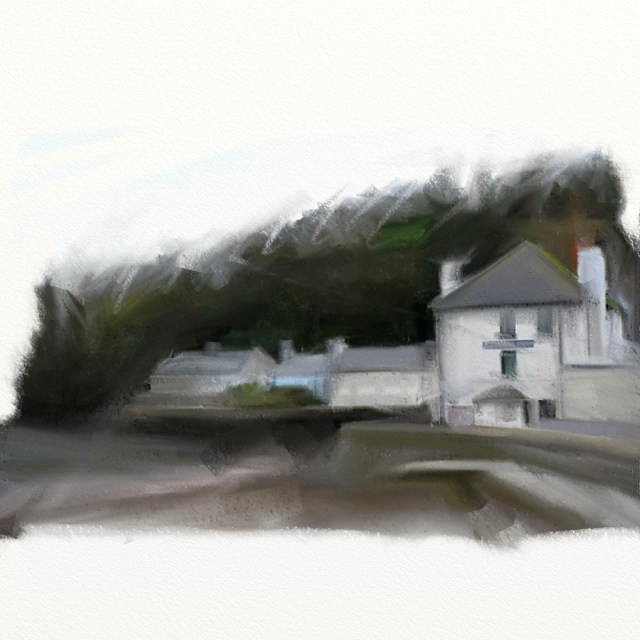
UNDER BLUE ANCHOR
They were singing The Parting Glass. The fire was high. Some eyes were closed with the weight of the song; others gleamed. All there were drinking hard.
The windows ran with condensation and rain fell straight in the windless night. I rose and threaded my way to the door. From woodsmoke, I stepped into seaspray.
From the crossweave of the song, I stepped into the cry of gulls. Sickle wings looped and turned in the dark. I sat on the wall and thought of home. I lifted my face
into the rain and thought of you and the children. All of you asleep – your hair auburn-red over the counterpane, their faces spellbound. And I called along the alleys
of the rain and out across the tenements of clouds to where you lay sleeping, thinking not to wake you but just to stand for a heartbeat at the corner of your dreams.
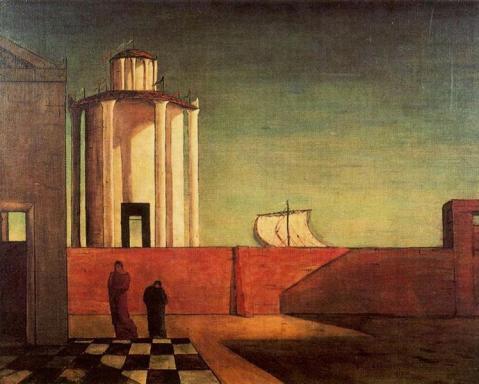
Another restless night. At 01.20 I stood at the window watching the skyline. During previous bouts of insomnia, there was always something faintly comforting about the long, probing lights of planes flying into Luton Airport from the east and descending elegantly behind the trees. Others awake like me, but in transit from Sofia, Talinn, Lyon, Kutaisi, Reykjavik, Cork. The enigma of arrival.
But in the small hours this morning nothing disturbed the skyline. And my sense of solitude was strangely heightened by the sudden doppler whine of a motorbike speeding by on the road below. But, of course, the solitude is real and its sense is pervasive. Yesterday we went for a walk. We crossed the fields and walked down the long slope of the lane. We were passed by just one car before turning onto the muddy track that took us past the farm and onto the bottom of the hill leading up to our house. As we walked alongside the meadow where the horses are grazed, half way up it a lone figure was slipping a bridle over the neck and head of a piebald shire horse. She turned as she gathered it into her arms and saw the three of us paused by the fence. With the solemnity of the stay-at-home edict still fresh in our minds, there was a curious hesitancy in the distant encounter. Then the woman slowly raised her free arm in a strangely stiff and formal salute; we returned it in similar manner; she turned and walked towards the stable buildings and we continued on our way.
So suddenly we’re strangers in a strange land. And as the economic structure purées all standard procedure around us, the normal social protocols go into suspension. In one street an act of inexplicable cruelty and stupidity occurs; in a parallel street the self-sacrifical kindness of a stranger demonstrates the extraordinary generosity that ennobles humanity in crisis.
And it’s all broken apart in a little over a fortnight. Here we all are inside our familiar house, moving from room to room, eating meals, binge-watching on Netflix, carrying our laundry upstairs, face-timing friends, sweeping floors, insulated briefly from the Mystery. But the outside world that we scrutinise through the windows has fallen away. The trees and fields and pathways prevail, but the few passers-by hasten in their transit as if anxious only to draw their own walls swiftly around them so that they too may themselves move from room to room, glancing now and then through the windows.
Ólafur Arnalds – Particles, featuring Nanna Brands Hilmarsdóttir.
I’m okay during the day. There’s lots to do and in between the TV bulletins updating us on the steepening infection curve, the increasingly ravaged images of angry, exhausted doctors and nurses on the front line and the sad, baffled faces of politicians sharing our fear and incomprehension, I’ve been here before: I’m on holiday and the time beat of the day has adjusted to the slow, muffled background thump of hours without agenda or direction.
But at night I wake up suddenly. I open my eyes and the stars are looking back at me, cold and indifferent. Sometimes I’m able to sleep again immediately. But too frequently there’s something about that indifference, that absolute implacability that has me out of bed and downstairs, fearful and alone…
THEIR VOICES IN THE NIGHT
Unable to sleep, I sit before the heartless brilliance of the screen with the real-world darkness
hovering, fresh-minted, glossy at the window. It’s as if time has packed her bags and left
for the coast and then beyond. Fear leans on the back of my chair in his poacher’s coat, deep pockets
full of gin-traps, poison, shiny knives. I take off my glasses, knuckle away the mess of my tears. And then,
like a gaggle of drunks through a suddenly opened door, the geese are overhead. Some crass dispute
as to the whereabouts of water in the impossible night, their voices skronking inside a collision of
cranking necks and wings. As they tumble through the unseen clouds, I laugh out loud and love them all
for their unconsidered vandalism, neither thought nor theory troubling the palate of their need.
I stood looking out of the kitchen window. Hardly a breeze; everything very still. Early violets studding the grass; those last daffodils; the may pushing through the privet. The unconscious persistence of nature set against listening to the Canon Triplex In omnem terram exivit sonus eorum by Benedetto Marcello from the radio, caught by chance at that moment. Tears streamed.
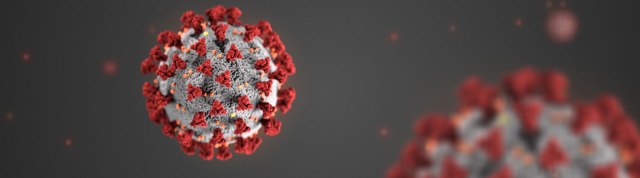
It’s too easy to interpret that persistence through the medium of the emotions, as if these synchronous moments represent some kind of absolute compact between nature observed and our attempts to frame the numinous through music. But Covid 19, the latest in a group of disabling corona viruses, is moving amongst us with the same unconscious persistence. And to the epidemiologist that microscopic floret-bearing globe will have beauty too, even as it exploits our immune systems through sickness and maybe into death.
Spring is officially wide open on Friday and with its cautious warmth and early blooming we’ll feel hope as we open doors and step into it. Easy to emotionalise the big, pale blue skies and the sudden blossom amongst the spiny branches still pushing out their buds. The best we can manage amidst the fecundity of Covid 19 is fear.
Day 3 of family self-isolation. But it’s a spring Sunday and the daffodils are still in full cry across our weird bumpy lawn. I tried for some solemn moments yesterday. I had a how-to-cope list on my knee that started off with the words, ‘We don’t know what’s in store and we don’t know for how long…’ But everyone giggled so my Swiss Family Robinson pater familias role went up in smoke before I could get to the hard-core survivalist stuff.
So life goes on much as usual with only flickers of newsreel images in the tail of an eye or the sententious tones en passant of another rogue epidemiologist calling out the government for indecisive management to remind us that this is only the beginning. This morning when the girls were up in our bedroom for Mother’s Day a barn owl swept across a skylight whilst higher in a pale blue sky two red kites sauntered around the thermals. We have enough in fridge and freezer pro tem and the local village store and our beloved Red Lion are opening up as conduits for supplies. Behind me now a crop sprayer crosses the field with radials at full spread like some crazily optimistic aeronautical folly. Cars thump pass and a Harley-Davidson hammers along in its own blue smoke behind the Stevenage bus. We can all still hold our collective breath because this is only the beginning.
It’s still outside, save for the cars passing. I’m home alone. Sunny on the fields, but cold inside because I daren’t overtax the two 47kg LPG cylinders that comprise our entire gas supply. Better to wrap up during the day and disseminate a little heat in the evening when everyone’s home. Just one delivery driver down with the C19 and we go without for days. Eric Whitacre’s ‘Allelluia’ is on iTunes, volume down so the distant voices seem to be percolating through the walls.
I don’t feel fear for me. Those microscopic naval mines will come bobbing by if they will. And if one bumps my bows then I’ll brace myself for the muffled boom and hope that the damage stays above the waterline. Much more concerned for family members. They have asthma – not severely, but the ash trees are self-germinating now and they’re promiscuous with their pollen.
So not afraid for myself, just sad, terribly sad. Bereft, I guess – so sudden a loss. The Tuesday before last I was at Steve and Jo’s for our weekly music session. I had a bassline to put on a song of Gemma’s after which we played through Steve’s and my two latest songs. Then there was to be next week at mine and the following at Steve’s and so on into our mutual indefinite futures. Now Steve and Jo are in voluntary seclusion through the months ahead and the shared music that has for each one of us served our souls in troubled times must await the silent, invisible movement of this toxic global cloud.
That’s my immediate sorrow. In the world at large there’s ‘a drawing down of blinds’ as everything that has animated our quotidian lives for generations ceases, bringing about a huge empty, uncomprehending vacancy. From those hastening up and down the corridors of power to the puzzled soul standing alone in a once busy street, no one knows what must happen next. The Four Estates are dumbfounded. All about us the signal-to-noise ratio loses out to mere babble. A rumpled, baffled PM mangles his silver spoon vowels, turning with ill-concealed relief to one of the two skeletal science supremoes who flank him on either side. I watch the mouths flapping and think of Yeats: The best lack all conviction, while the worst / Are full of passionate intensity.
I sleep fitfully, wondering in my momentary half-consciousness what it is that’s shifting out there in the darkness. And in the morning I know.
« La poésie, c’est l’art de bâtir des ponts entre ciel et terre » Michel Deverge
French poet Michel Deverge was no artist-in-a-garret. Once a cultural, scientific and technical attache to the French Embassy in Singapore, he was also an art critic and philologist with a specialisation in Chinese Studies. His poems are quirky and surreal, reflecting in their minimalism and delicacy the influences of the East. Here are three translations. I have several more in preparation.
THE PUNT
the fish watches the maggot and the line and the rod and up there on the end of the rod in the stern of the punt beneath the spreading shadow of his hat the angler asleep in the sun.
the lapping of ripples against the flat boards set against the rustling of the reeds the punt solitary on the great lake the fish its warder and the silence its cell.
…
THE MASTER WAS POLISHING A BRICK
The master was polishing a brick the pupil asked why are you doing that the master answered to make a mirror the pupil said you can’t make a mirror from a brick the master answered you can’t become a buddha by sitting amongst the lotus
…
THE ASPARAGUS
The asparagus tip cast a morning glance across the beach close by the basket the kitchen knife
On the publication of my first collection ANCIENT LIGHTS a few years back, I was interviewed online by a friendly editor (they’re out there!) for an article about poetry and memory.
Many of your poems in ANCIENT LIGHTS are concerned with time and memory. How do you use memory as a muse? When you revisit a memory in a poem, what does it feel like to you?
I never seek out memory consciously as some kind of goad to inspiration. I can only write in response to a jolt from inside or out and long periods may pass between such events. Then a small linkage of words or a complete line will simply appear, often enough in the midst of a sequence of completely unconnected thinking. Many poems begin when I’m driving on my own. The pairing of concentrated attention behind the wheel and the freewheeling bundles of random thoughts stimulated by music that might be playing or by the passing scene seems to provide particularly fertile conditions for the start of a poem. It’s within this kind of creative context that memory might interpose itself at some point. So there’s no conscious attempt to site an emergent poem in some recollection of the past: if it’s going to happen it will simply happen. But when it does the greater likelihood is that a first draft of the poem will be completed swiftly and its emergence will carry with it an immediate and commanding emotional charge.
There’s an example of this in the writing of In The Daubigny Chapel. I was driving from Hertfordshire to Hampshire, a journey of about two-and-a-half hours along linked motorways alongside which the changing topography is very apparent as the time passes. A CD of Brian Eno’s Discreet Music was playing – unobtrusive, as it was designed to be, yet evoking an atmosphere of contemplation and reflection. Around me the great flat fields of the East gave way to the hills of the Southern downs. And at some point out of nowhere a line came into my head: Mice are in the organ loft. I can hear their scratch and scatter… Instantly I knew in what church that organ loft was situated and what scene from my past was unfolding beneath it. Within 20 to 30 minutes I had the first nine-line stanza composed and when I stopped for fuel I quickly wrote it down. By the time I reached my destination I had the second stanza in place and I scribbled it into my notebook before conducting the business in hand.
And then most of the way home I pondered what had happened – how out of nowhere a line had materialised, followed rapidly by a sequence of supporting lines all following a narrative course culminating in a conclusion, the whole linking long-past experience with present perception. The poem had evolved with a kind of steady urgency, its intrinsic mood and atmosphere developing with the falling of the verses and now, as I drove home, I was gripped by the resonance of the memories contained within it and their significance to me now decades later. It was as if the poem had performed a kind of partial decoding process, encapsulating an isolated sequence of events, undramatic in themselves at the time but clearly of considerable moment within a much broader, deeper consciousness now. It’s in this kind of way that memory and time underpin much of my poetry – unbidden and yet compelling in its essence and purposeful in the process of its composition.
In Burn Norton from the Four Quartets T.S. Eliot has four lines that I have always cherished for its representation of the factual imprecision of memories which are nonetheless vivid and powerful:
Footfalls echo in the memory Down the passage which we did not take Towards the door we never opened Into the rose-garden.
I can’t answer for other poets nor can I project some general principle for the greater function of memory within verse. But I have long believed of my own work that in part at least its substance arises from deep within both my active and passive resources of recollection. And it’s been apparent to me for a long time now that each of these memory-driven poems carries within its imagery a set of ciphers. These may or may not be clearly comprehensible to me, but I will always recognise in them a potent significance in respect of what they describe at the point of occurrence and an enduring and informing consequence now.
IN THE DAUBIGNY CHAPEL
Mice are in the organ loft. I can hear
their scratch and scatter, tiny scraps
of moss on the move across the bones
of their ancestors. July sun shimmers
the riches of the windows. And down
on the south aisle floor, sprawling like
a scrubbing penitent, your golden hair
across your face, you lift the brass
up through the paper, inch by inch.
We are in the blissful moment, you
and I. Light and time reiterate
and the motes of dust stand still.
You look so young, so beautiful that
I barely hear the voice that murmurs,
small but clear, ‘You want. Not need
but want. Know this now and then
down the long noise of the years.
A re-drafting of a poem posted to this blog a couple of years back. Relevant then to me as I continued to make my increasingly cautious way forward into the years immediately ahead, it resonates just that little bit louder now.
FRAGILE
Much as at the point when suddenly rain stops, or wind abates, or cloud obscures the sun,
there is a moment just between breathe in and breathe out when shock stops the spin and hum of it all
and in the silence and the stillness we are changed entirely.
At this point the surgeon reads morbidity into the slip and twist of tissues, the plasticity of form, the salt and vinegar of juices.
And from then, back on the street, you may glimpse over and again around the crook of each and every corner,
mortality’s black sleeve flapping like a torn flag.



 sisyphus